By Aria DeLara
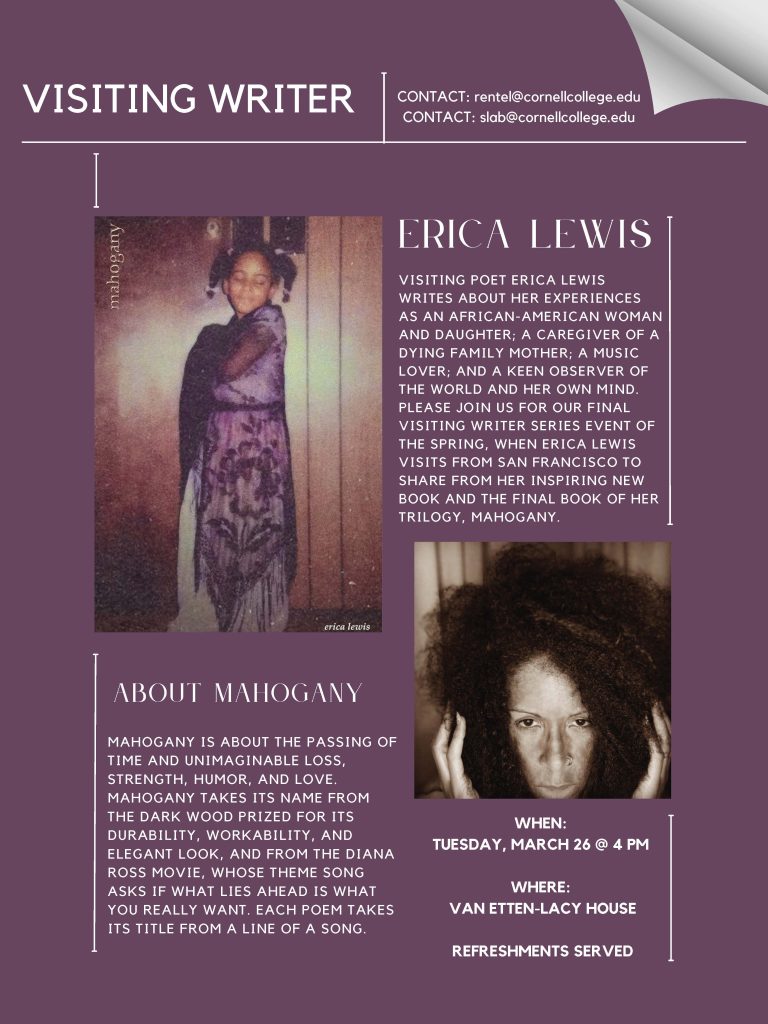
Hello! My name is Aria DeLara. I’m a Creative Writing Major, 1st chair cello of the Cornell Orchestra, consultant at the Dungy Writing Studio, RA, and Treasurer of BOOM, which is a magazine here on campus. Two weeks ago, on March 26, of 2024, I had the splendid opportunity to speak and listen to Erica Lewis as she read her newest collection of poems titled Mahogany, at the Van Etten-Lacey House.
TW: talk about loss of family
The event itself was very cozy and welcoming—we were provided with hot cocoa (with marshmallows!), fruits, and flyers about other upcoming events. We found ourselves lounging on a mix of chairs and couches, students sprawled throughout the room to chat amongst ourselves while we waited. When Lewis arrived, she sat with us, and we were given a chance to talk together while other students kept trickling in. I learned that she had just arrived in Iowa from Ohio, and that the colorful bracelets on her wrist were a gift, homemade and plentiful. It made me think back to the necklaces my childhood friends would make me on the playground, usually as much dirt and dust as beads strung along the stolen strings.
I had never heard Lewis’ poetry before, never heard her name, so it was a pleasant surprise to hear in passing that the poems in the book she’d be reading from were all inspired by Diana Ross’ discography (my mother loves Diana). When she began reading, I realized very quickly that I had closer ties to the subject matter than just a love of 1960s singers. The poem books (a three-book series), she told us, were also an outlet for her to continue processing the loss of her mother. Being a profound mama’s girl myself, listening to these poems hit me hard. They were like the manifestation of each of my own existential thoughts about the future, and sitting there as word after word flew off the page and poked me in the chest was both painful and cathartic to experience.
I took comfort in the solid knowledge that other people had experienced what I feared for the future, and they survived it. I cannot overemphasize the vulnerability and pure love that Lewis’ was able to bleed out from not only the page, but also her voice in that reading. Every syllable, every description felt like it was full of not only anguish, but heartfelt devotion. I found myself enraptured with the emotionality in her voice, and the sheer gratitude I found myself feeling that Cornell afforded us the opportunity to hear her speak in-person.
After the reading, Lewis took questions and she told us a bit about her process, as well as the countless colored neon tabs littered throughout the copy of mahogany she had read for us. They were paths, she told us, different ways one could read through her work to achieve different results. The path she read for us was meant to elicit the major themes of the larger collection, and pull together the repeated phrases and anecdotes that appear throughout the poems. She told us of the origins of her series, about a pen pal she had been exchanging similar song-poems with, each poem taking their titles from lyrics in artists’ songs, and eventually creating so many that she had the inspiration to make a collection. We chatted for what must have been an hour, coming down from the emotional experience as a group. Before I left, I bought a book, my own signed copy of Mahogany, and scored myself a free hug from Lewis.
As someone who hopes to go into editing in the future, seeing, meeting, and getting to know such incredible artists, like Erica Lewis, is deeply moving to me. This wonderful experience has encouraged me to pursue others like it, and I will be keeping my eye on the campus event calendar in the future for other visiting speakers.
**
Much of my own poetry stems from a desire to process my complicated childhood; so, naturally, as soon as I walked out from that reading and the day was over, I sat down to have a good cry and decided to crack out some poems of my own. I wrote a poem that comes both from my reaction to the passages that spoke to me the most during Lewis’ reading, and from the story my mother would always tell me about my birth.