Author: sdohmen28

  • Return of Statue Ceremony by Zoé Lebrón Pérez

    I’m Amanda Zoé Lebrón Pérez, a Creative Writing and Musical Theater double major, as well as a performer in multiple shows from Cornell College. As a woman born and raised in the tropic, Puerto Rico, I despise the cold with all my might, but find certain consolation in music and writing. As the semester unfolded, I got myself deeper into the Creative Writing major, taking as many writing courses as I could, joining the literary citizenship adjunct, and attending a variety of events that in majority aligned with literature. However, among those events, there was one that was not precisely related to writing, but made me reflect on things like true knowledge, ignorance, and what a true community should be. This event was called the Return of Statue ceremony.

    On September 30, 2025, Cornell College returned a Mississippian Native American statue, which had been in the institution’s art collection for decades, to its rightful owners, the Muscogee tribe. It took place in McWethy Hall, the building of the arts and art history department. Four representatives from the tribe attended, gave a small interview/lecture on their culture, as well as why and how they were searching for that statue and many more – since there are hundreds of them scattered around the world. The answer: an act that would culminate with the burial of the statues in the land they were taken from, a symbolic gesture that would contribute to the tribe’s healing after the desecration of graves and land caused by the US government. At first, I thought that the ceremony would simply be a public demonstration of attempting-to-repair the wrong doings of white ancestors, on the college’s part. However, while it certainly had a bit of that, it went a step further, welcoming people from real Native American ancestry to pick up the artifact. Not only that, but the ceremony gave them the chance to speak openly about the history of their people, their beliefs, their mission to recover every lost artifact, and the origins of the returning statue.

    Essentially, the statue was a sacred object, hand-carved in stone with the shape of either a man, a woman, or a snuggled couple. These would be given to the new tribe chiefs on their first day as leaders or as birthday gifts, representing the status of chiefs and the love of significant others. Once the owners died, the statues were buried alongside them. Needless to say that when colonizers took the natives’ lands and excavated in search of something to possess, they profaned thousands of tombs, extracting statues that were meant to stay beside their deceased owners for eternity.

    It was clear how important it was for the invitees to recover those sacred objects, their cultural heritage. They strive to recover them at all cost, to rebury them near their original tombs – since there is no way to bury them exactly at the same place after a century from their extraction – and bring a closure to the still open wound that those grave desecrations provoked. Overall, the whole interview and the return of such a significant piece made the ceremony a gratifying event to witness. In its entirety, the ceremony reminded me of an Intercultural Anthropology course I took two years ago, a class whose purpose was to educate about different cultures around the globe, race, ethnicity, and more. However, the time and material was so limited that I barely got to learn anything about Native Americans. The Return of Statue event made me think about all the cultures and history I have left to learn about, the many things I did not get to learn in that Anthropology course, and the many things people still remain ignorant of due to the relegation of the original residents of this land. From this, a desire to learn more from Native American cultures arose, something that will become a new short-term goal for me, a way of cleansing my remaining ignorance, probably through more anthropology subjects and/or by attending other events similar to the ceremony.

    For the opportunity to learn things never taught in school nor even college, and the chance to break the barriers built by relegation, this event was truly interesting to witness. Bringing people together who have been long separated by social injustice, and contributing to the healing and education of next generations to prevent past mistakes is something to be applauded. Moreover, being in a gathering alongside people from different cultures/upbringings, all as one sole community made me think about the writing adjunct, one whose purpose is to bring people together as this ceremony did, literary citizenship.

    Literary citizenship is to be part of a community of writers that gets involved in literary events, mostly to stay active in the craft of writing or get inspiration, but this concept falls short on what I believe an adjunct like this should be. More than just going to activities, literary citizenship should be more about contributing to a community rather than just being a passive participant of one. As Lori May’s quote indicates in The Wright Stuff, “Literary citizenship calls on our acts of giving, of giving back to the ecosystem so that we may actively ensure its sustainability.” Attending events, weekly meetings, writing together… These activities are about individuality, even when they are collaborative, because they are all about personal gain: improving skills, expanding connections, and reading for one’s own amusement. Contrary to this, I believe literary citizenship should be associated with other types of events that involve a stronger sense of camaraderie and an active, significant, contribution to a community, even if these are not strictly related to writing.

    The ceremony encapsulates perfectly the idea of being active, intentional, knowledgeable, and giving within or towards a community. Showcasing genuine interest for the Native American’s history, struggles, goals, and significance of their sacred objects is a way of literary citizenship. Acknowledging that past wrongs cannot be fixed but can be learned from is also a type of literary citizenship. Choosing collectively to do the right thing and make an act of giving, in this case returning, is in fact literary citizenship. So despite being unrelated to literature, the Return of Statue ceremony is not just what literary citizenship is but what it should always strive to be, a group of people giving and sustaining an ecosystem based in compassion and camaraderie.
  • The Underground Railroad by Elena Gonzalez

    My name is Elena Gonzalez, and I am a senior here at Cornell College. My major is Creative Writing, with a minor in Studio Art. I am the President of the Craft Fair and involved in the Leads Program at Cornell College. I am the Secretary of Alliance, the LGBTQ group on campus. I am a work-study student for General Athletics as well as a student worker in the cafeteria. I am a general member of PAAC, the Performing Arts and Activities Council.

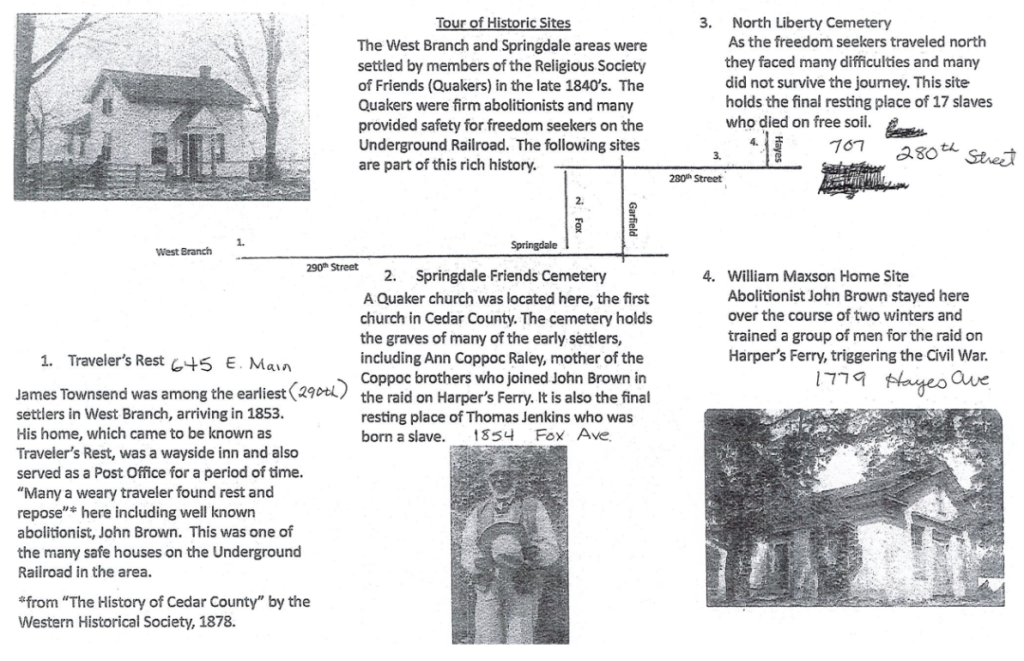
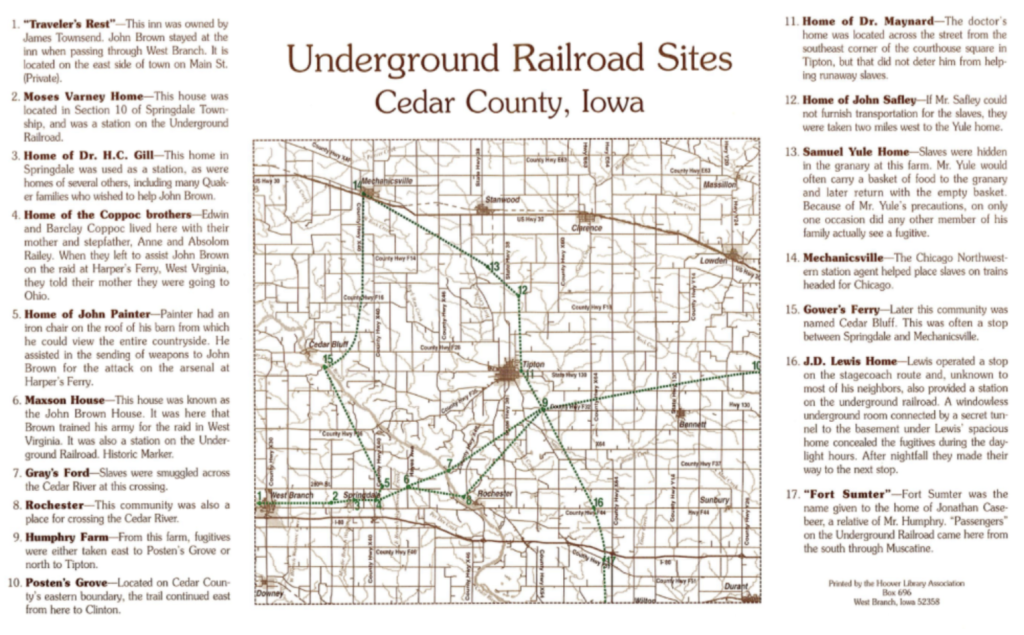
    The event that I went to was the Local Underground Railroad. Peggy is from West Branch and is the presenter for the event. She went to give a talk about the Traveler’s Rest museum at the Methodist Church in Mount Vernon. She lives in the Traveler’s Rest house. She moved into the house back when her father fought in World War two. The Traveler’s Rest was one of the biggest safehouses for the Underground Railroad. She is one of the protectors of the house. It was bought by her grandfather, then her father inherited it and Peggy inherited the house from him. It was built in 1851. She is one of the protectors of the underground railroad. Peggy said that John Brown was a conductor and abolitionist of the Underground Railroad, and he helped with freeing the enslaved people to get to the promised land and live free and not enslaved by other people.  It is called Traveler’s Rest Museum, and the caretaker is Peggy Harman, who moved here when her father fought in WWII. Underground Railroad museum.

    In 1850, Iowa was a free state, so it was legal to free a slave in Iowa. Traveler’s Rest was a station that freed slaves using trains, the underground railroad, regular railroads, and wagons, driven by horses, and they had to cover the enslaved people with potato sacks to keep them from being spotted. The fugitive enslaved people had to obtain tickets to get onto trains for the Underground Railroad. The enslaved people wanted to go to the promised land, which was actually Canada at the time. There were safe houses located for people to stop and stay, and eat raw field corn. Fugitive enslaved people would stay here for hours up to a day at most at a time. There was a woman who owned one of the safe houses, and she would make sandwiches for the people who were enslaved. She would let them take the sandwiches with them to eat them as they traveled on the Underground Railroad. This was important for the enslaved people because they would not be able to survive on cold corn that was picked from the fields. They would need actual food to survive and be healthy, or else they would die from improper nutrition.

    I thought the event was super cool. The thing that I liked most about it was that Peggy knew so much history about the Underground Railroad, and how she knew that the house was in the middle of Iowa, and Iowa is now considered the halfway point of the Underground Railroad’s travel path. I did learn a lot more about the Underground Railroad after this talk. I did not know anything about the Underground Railroad. I was supposed to learn about it in school, but we were never taught about the Underground Railroad because of COVID shutting down schools. Going to this talk connects with my plans for the future. When I graduate from college, I plan on becoming a journalist as well as a children’s author. I like to write about events that I go to and tell people about the things that I learned while I was at the event. Attending this event helped me practice and prepare for what I will experience in my future career as a journalist.

    The event that I went to next was the Black Out Poetry with Lyrically Inclined. I learned new information from both events. For example, the information about the Underground Railroad. I didn’t initially know how intricate of a system it was to free enslaved people and how long it would be of a journey to get them to the “promise land”. As for the blackout poetry night, I didn’t know about the rules of poetry before I went to this event. At one point at the event, I started clapping, and some of the audience members I was with corrected me and said that it’s more polite to snap, but I didn’t know how to snap. I also learned that people saw I was more interested in their poems by snapping my fingers in the middle of them reading their poems.

    Websites for the Underground Railroad:

    https://iisc.uiowa.edu/projects/west-branch-travelers-rest-and-west-branchs-history-underground-railroad

    https://www.nps.gov/places/000/travelers-rest.htm

    Peggy: https://www.westbranchtimes.com/article.php?id=21454

  • Writing for DnD by Austin Palm

    Hi there! My name is Austin Palm, and I’m an English – Creative Writing major at Cornell College. If you’re a student, you might recognize my name from some articles in recent issues of The Cornellian regarding our esports teams and what they’re getting up to. Outside of writing for the newspaper (and classes, obviously,) I haven’t spent much time with the creative side of creative writing until this December. You see, late this year I joined a group of my friends to play Dungeons and Dragons. We play every Saturday, and it’s a great way to socialize and make sure we have time to hang out every week.

    Like many DnD groups, we play entirely online due to the distance between us. Our Dungeon Master and his wife who plays in the party live together in Indiana, and another player lives nearby. Outside of that, one of us is in Texas, I’m here in Mount Vernon, and our furthest player is all the way in Germany. In short, meeting up in person every week is a little bit out of reach. That being said, I wanted to imagine what one of our sessions might look like if we were somehow able to play consistently in person. One Sunday after we had played, I opened a blank document and began to write. It had been right after a Thanksgiving themed session, drunk uncles and cousin walk included. I wanted to capture the more goofy and casual vibe that our characters had experienced, so I wrote as if we had just finished the session, playing in our DM’s basement rather than on a group call, miles apart from each other.

    Writing simply for the joy of it was amazing. I couldn’t even say how long it’s been since I wrote something without a rubric or requirements to dictate the quality of it. If the vibe of something was right, I wrote it. If it didn’t fit then I tried again. There was no time limit, no upcoming peer review, no grade to strive for. I wrote my friends’ personalities and dialogue the way that I know them without trying to create characters that fit a certain role in a story. The only audience ever reached is the group itself, so there was no worries of it being critiqued by the public. I just wrote for four hours, ran a spellcheck, and sent it to the group chat without even proofreading it. Hearing the party’s response to the writing was incredible as well. I was worried that my friends wouldn’t enjoy what I made, but the reactions were the exact opposite. They were all excited to have been included in the story, some even saying that the way I wrote them was pretty much exactly what would’ve happened if we were actually close enough to play in person.

    Since this instance of just writing out of the blue, I’ve started just throwing ideas that I have onto documents to get them started. Even if it’s just a few sentences of interaction between our characters in game, or how we’d react to something if we were sitting around the same table together, there’s no reason not to. It’s much more fun to write something for yourself, and if it’s fun you’ll put more effort into making something you’d be happy to read. TLDR: Writing for fun made me realize that writing is fun.

  • Exploring the Cemetery by Frida Hilbrich

    My name is Frida Hilbrich. I am a senior Photography and Creative Writing major, and my interests include writing poetry, photography, and painting. A highlight for me this year was going to the Mount Vernon Cemetery for the first time in the four years I have been at Cornell College.

    Today, a small group of us, students and faculty, walked in the Mount Vernon Cemetery to see some of the original Cornelians’ gravestones.

    A lot of the teachers that originally came here to Cornell in 1800-1820 came here to work. They lived and died here. Many were part of the Civil War and were also probably some of the most interesting people that we have had in our College history. One of the people that was buried in the cemetery named Jewel Bothwell Tull, was a writer and a playwright; her husband worked here on campus as an English teacher.

    Last year me and a group of three other students transcribed a couple of chapters from her book called Sylvia of the Stubbles. I remember really connecting to her, because she was a poet at a time when women were not really seen as capable of the same intelligence as men.

    The cemetery is falling apart; it is over 200 years old. But, it still has a beautiful and peaceful nature emanating from its very being. In this cemetery, there are hundreds of people who founded buildings on campus and other historically significant places in Mount Vernon. There are also hundreds of past Cornell
    professors, faculty, and founders.

    The people here are buried on rolling hills. Family members who have passed are buried together under willowy, overhanging trees older than they were. The trees create a canopy over the headstones of the dead.

    There are gravestones that don’t have words anymore, so we don’t know who’s buried there. It would be a cool job for students at Cornell College to try to figure out who is buried there and what they did or who they were. There were a lot of them; it made me really sad, and I feel like those people deserve to have their names known in the place they were buried and possibly the place they were born and lived most of their life.

    Being an artist and a writer I found the cemetery in Mount Vernon to be an emotionally charged place but it could also be a place where someone could go to find inspiration for names for characters in a book they were writing.

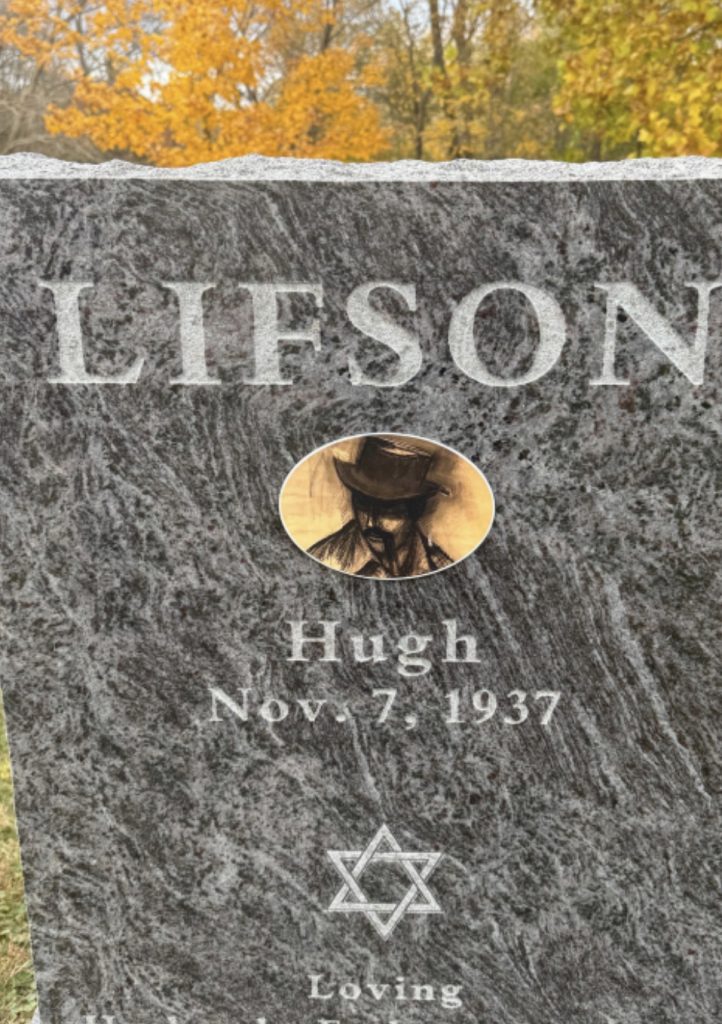
    One particular headstone caught my eye. It has a drawing of a man smoking a cigar and a top hat. I later found out he was an art teacher at Cornell for a very long time.

    Because I am currently in a class based on Jane Austen, I am looking forward to an event being held on campus for Jane Austen’s 250th birthday dinner on the 16th of December. There’s going to be singing, music, readings from her books, and snacks.

  • The Printing Press by Sophia Dohmen

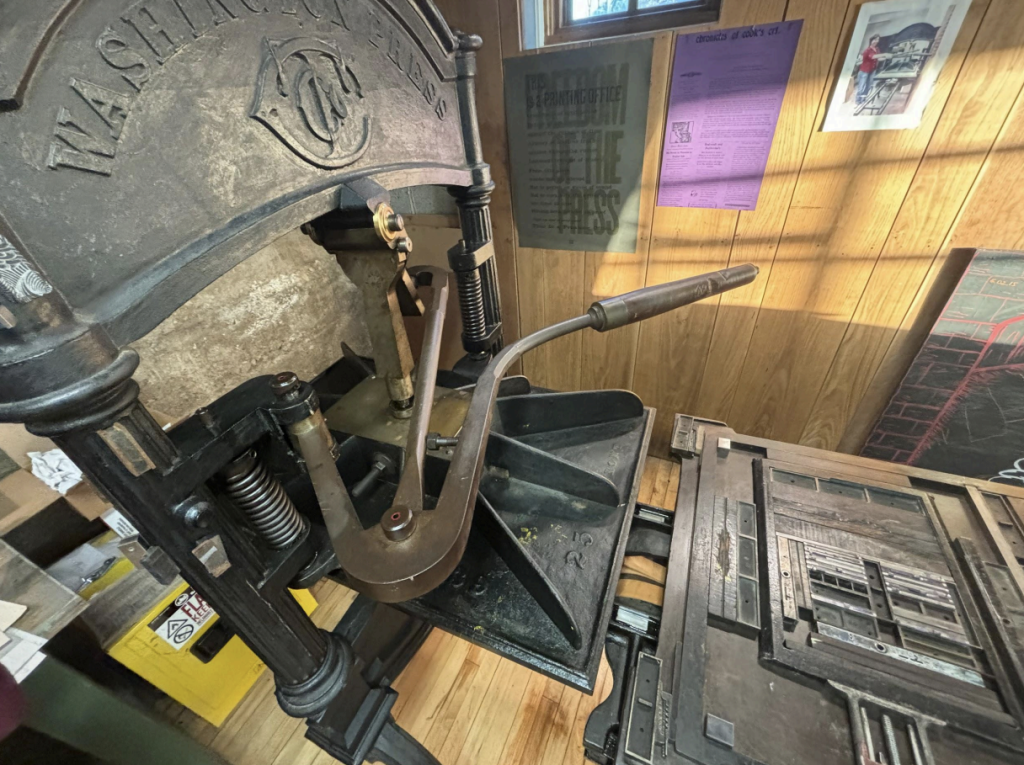
    My name is Sophia Dohmen. I am a sophomore Creative Writing major and the Van-Etten Lacey house is a very special place to me. In addition to just finishing the Novel Writing course, which met there, I also spent much of my free time there last year. I took an adjunct course called Book Arts and learned how to use the printing press among other book-making techniques. When I am able to, I like to come back and put some of the skills I learned to use on the print press.

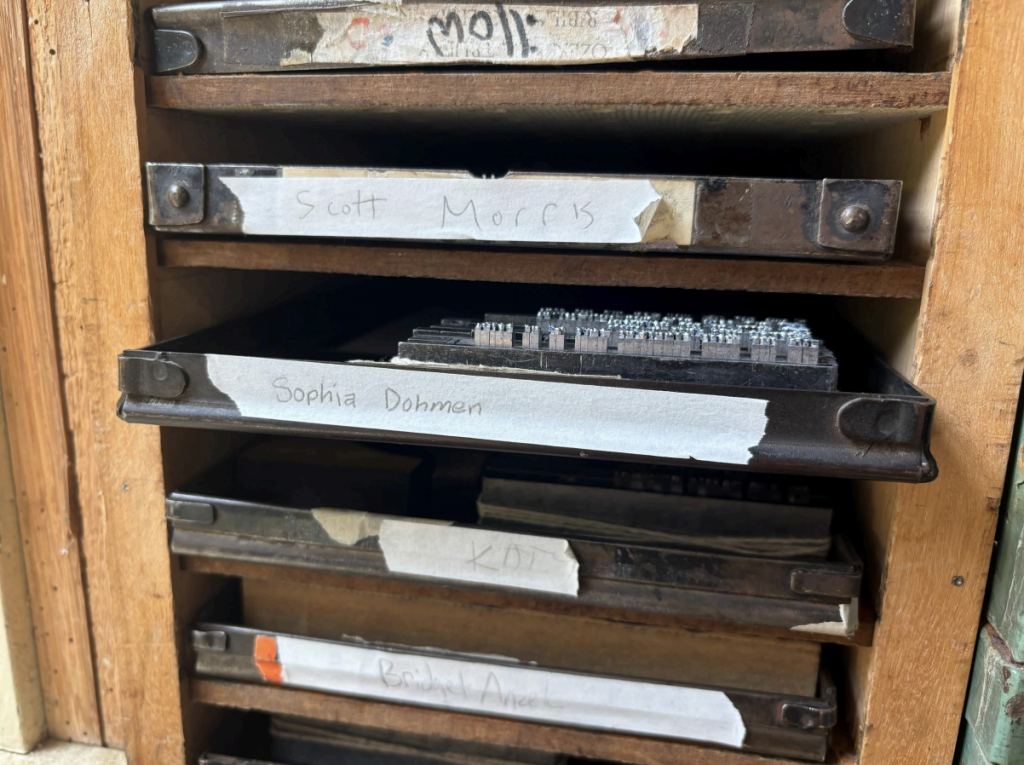
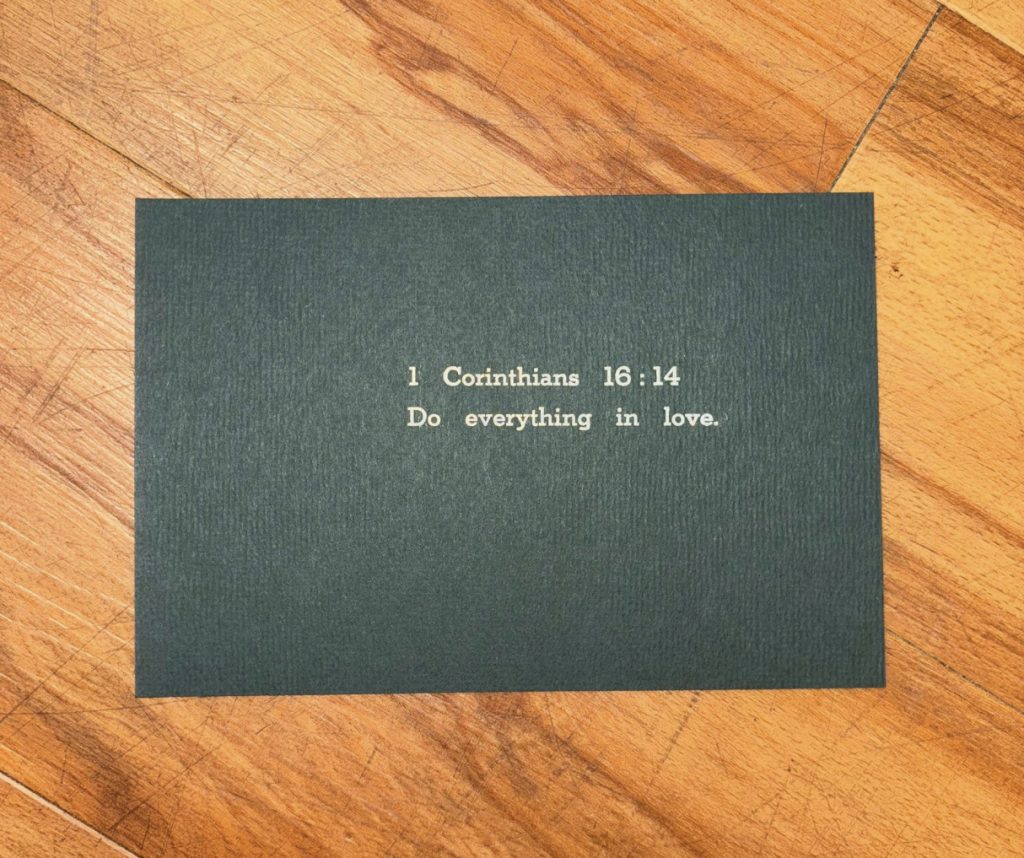
    I spent a Sunday afternoon in the basement of the VEL, composing my galley—a trey used for holding any equipment I may need during this process—with papers and steel. One by one, I picked up a letter and added it to the composing stick. I placed each individual letter down, forming the phrase I wanted to print. Sometimes I use long passages of text, but on this particular day, I wanted something simple. I used the bible verse 1 Corinthians 16:14 (Do everything in love) to reacquaint myself with the printing press.

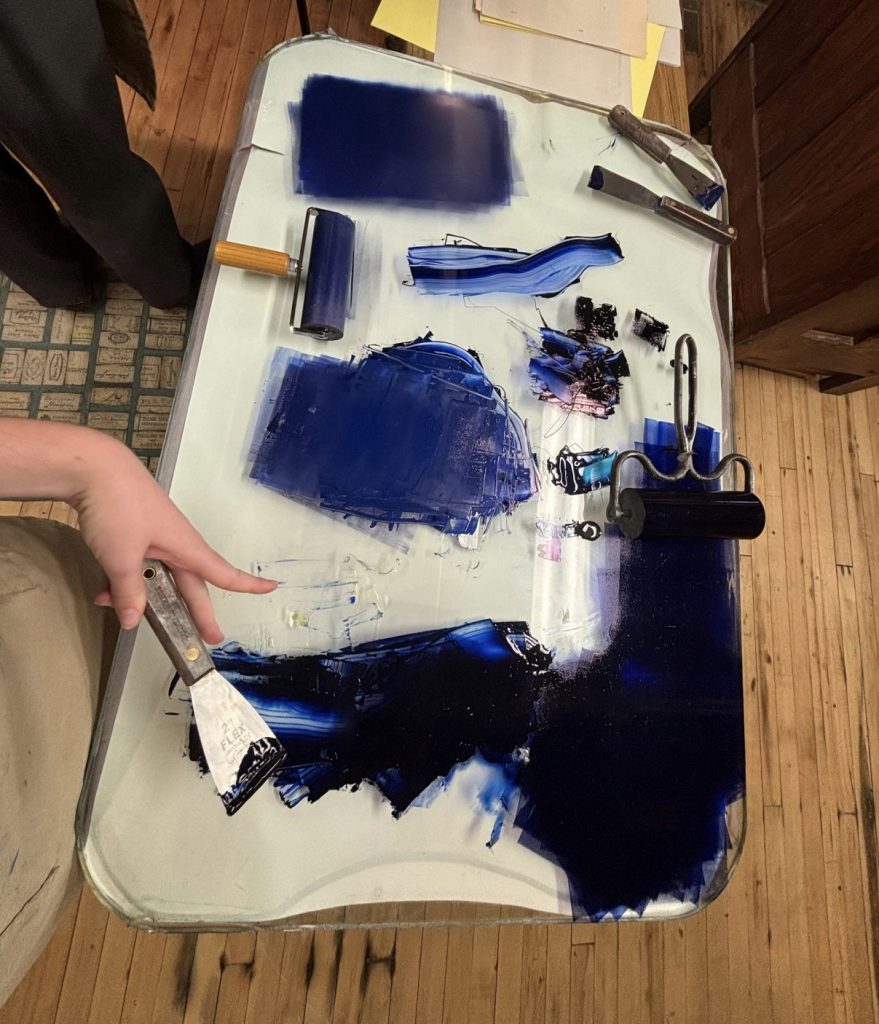
    I continued the printing process on that very Wednesday, when I returned to the VEL to roll my ink. My hands were stained green while I worked. I’d already locked the type set onto the press. I chose to use silver ink, which I added a dash of purple to. Mixing the ink is my favorite part. Getting to spread it out across the table is such a satisfying feeling, accompanied by scraping it back up, then repeating the process until the ink is mixed and at the proper consistency. Then, I rolled it onto the letters. Using the press again was soothing. I cranked the knob, sending my work straight under the flat canvas. I only need to allow the silver ink to press into the paper for a second before I crank the canvas back out. As I lifted the dark purple paper, I hoped for a clean print—it often takes multiple tries to get everything even. To my pleasure, the first copy turned out nearly perfect. Satisfied with the letter and line spacing, I started experimenting with other papers, seeing what looked best. Ultimately, my favorite combination with the silver ink was a piece of textured black paper. Once I’d made enough copies, I cleaned up, placing the type set back in my galley in order to make room for other people to use the press.

    This entire process reminded me of my time in Book Arts last year. I spent long afternoons, learning as much as I could from my instructor, Katy Stavreva. I worked on various projects involving the press. It is a space I’ve come to cherish, as if it’s a little secret most people on campus will never get to know. It very well might be, I’ve realized, as I’ve mentioned the VEL to kinesiology and engineering majors and received blank stares in return. They are
    missing out on something quite special.

    The next time I use the printing press, I have much more exciting ideas in mind. With the holidays coming up, I will be purchasing blank card stock and making holiday cards for my friends and family. I have yet to decide what they will say, but I know I’d like to use some of the holiday stamps held in the printing room to make the cards more fun.

  • Theatre in New York by Aniyah Shorter-Adams

    Hello, my name is Aniyah Shorter-Adams! I am a Creative Writing major with a minor in Theater at Cornell College. I have a passion for both acting and creative writing, and I aspire to build a career that blends both worlds together. Since attending Cornell, I have been able to take many writing and literature classes, like Intro to Creative Writing, Advanced Poetry Writing, and Novel Writing. These classes have furthered my love for writing and literature and helped me find my voice as a writer. In December 2024, I made
    my stage debut as Huldey in Cornell’s production of Jen Silverman’s The Moors.

    As an actor and a theater minor, I was excited for the opportunity to take the Off-Campus Theater Course trip to New York City. It’s been a life-long dream of mine to visit New York, and since I started pursuing a career in acting, it’s been a dream to move there. Cornell College provided me a once in a lifetime opportunity to explore New York City and see over twenty Broadway and Off-Broadway productions during the two week trip.

    My passion for acting lies in the film and television industry, but after the New York trip I am looking at theater through a whole new lens. Much of what I have learned from watching these shows, and from this trip as a whole, has inspired me to pursue more theater. I never planned on pursuing graduate school, but in New York I had the pleasure of meeting people, even some alumni of Cornell, who work on Broadway and thrive in New York. They all have pursued higher education, and my encounters with them have me considering the same.

    Ragtime, one of the musicals we watched on Broadway, is a beautifully tragic musical that makes such a poignant commentary on the social, economic, and political status of the
    United States of America. It is a play that is still relevant today, considering that the book was written in 1975, the musical premiered in 1996, and the story is set in the early twentieth century. It was the most moving and thought-provoking play I have ever seen, and is definitely one of my favorite shows we got to watch.

    I am a really big fan of the Stranger Things series, and I was extremely excited to see Stranger Things: The First Shadow on Broadway. In fact, I give credit to the cast of the television series for inspiring me to pursue a career in acting. I absolutely loved getting to watch this play live on Broadway. One of my favorite parts of the show was the amazing stagecraft, which included double screens and projections, body doubles, lighting and shadows, automated puppets, etc. Additionally, some of my classmates and I stood by the stagedoor after the show to meet the cast and get their autographs, and it was amazing to see how calm and down to earth the cast was after such an emotionally and physically taxing performance, which differs from working on a film set where actors sometimes need lots of time to calm down after hours of shooting difficult scenes.

    I think being able to work on the technical aspects of a Broadway production would not only be a lot of responsibility but also very rewarding and fun, especially when working on such a big show like Stranger Things: The First Shadow. I think that can also apply to film as well. I have an interest in working behind the camera as well as acting in front of one. I would love to work on the technical side of a film production, perhaps as the editor, cinematographer, or even Foley artist. As much as I love acting, I don’t want to limit myself to just one role.

    Being a part of the Off-Campus New York trip has been a highlight of my academic career. I have learned so much about theater as well as the city that I will definitely carry with me as I take the next steps in pursuing my career as an actor.

  • The Joys of Literature by Sophia Kohl

    My name is Sophia Kohl, and I am a senior who is majoring in English/Creative Writing and graduating a year early. I am a part of the Greek Group, Alpha Sigma Pi, and have lived in Iowa all my life. Some of my best English experiences on campus have been in classes such as NaNoWriMo with Professor Rebecca Entel, Fandom and FanFiction with Professor Katie Sagal, and Dante’s Inferno with Professor Katy Stavreva. All of these classes have given me an unforgettable experience that has reaffirmed my love for my major and given me stories to tell when people ask me about my time in college. Being able to have the opportunity to write a book as a block assignment, continuing my long standing career as a fanfiction author but in an actual educational setting, and journaling/discussing a crazed mans ravings in one of the most interesting settings that actually made me sad to miss class when sick (shout out to my group mates for always making it worth it to show up for class). In my senior year, I have also had a
    choice to explore the other side of the arts that Cornell offers. Shout out to Professor Stevie Delgado! I love your classes even though I can’t draw, and found that even in the instance of physical arts, I can incorporate my love for writing through creation.

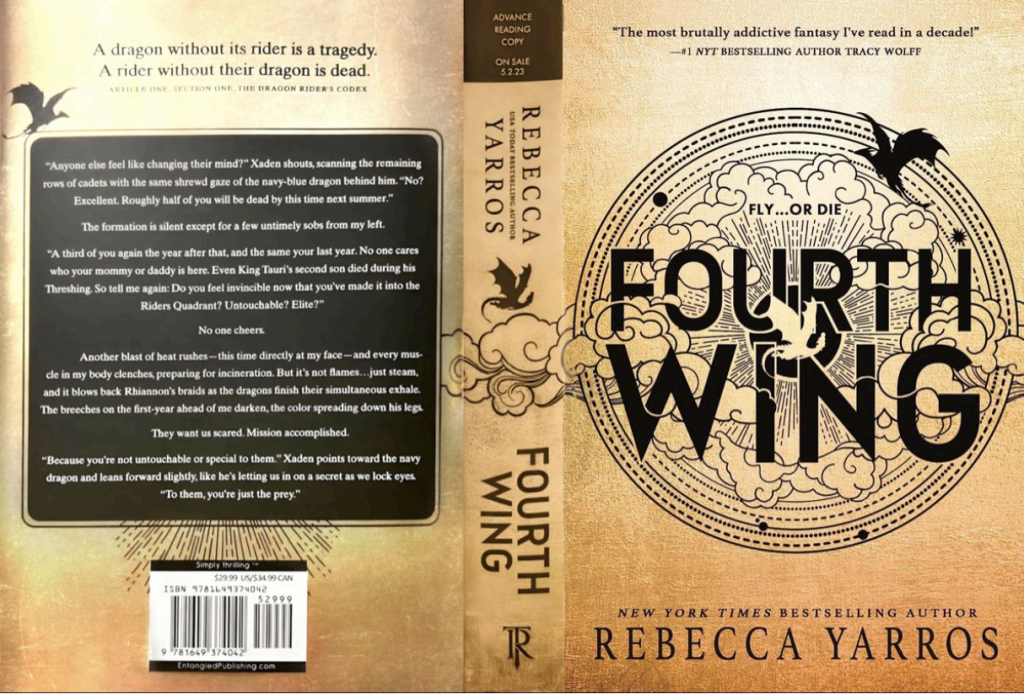
    In order to achieve literary citizenship as an English Major at Cornell, you have to total 37.75 hours in literary-related activities and reflections. I’ve always been a big reader, so I was pretty excited to be able to just read and have that count for a good amount of course hours. There were multiple instances that I could count down for this reading time (I read an ungodly amount of fanfiction every day), but I wanted to specifically focus on the book series I read. Fourth Wing by Rebecca Yarros is a trilogy that is ongoing, not that I knew that when I first picked up the series, and much to my disappointment, when I finished the third book. She has two more books on their way to publication. It takes place in a dangerous world in the main character’s dragon school. It’s kind of like Harry Potter for lovers of Wings of Fire and A Court of Thorns and Roses. Our main character finds herself bonded to not one but two dragons (an unheard of achievement ), and would she really be a main character if they weren’t also the most rare and powerful kinds that no one else has? It’s a whirlwind romance with a healthy amount of action and mystery. I read it all in one weekend, even though my friend called me a liar, which reminded me of when I was in elementary school and I wanted to check out an entire book series. My librarian said no because I wouldn’t read them all, which would lead to them sitting at home and getting lost. Being a notoriously fast reader, I took great offense to that and swore that I could do it. My librarian, a grown adult, said she would bet – yes, that’s right, BET – me a whole two dollars if I could read them all and complete a test on the series by the time Monday rolled around. Now, two dollars may not be enough, but for a kid whose ability had just been doubted, it was more about the pride of taking the money from her than anything. Also, the scholastic fair was soon, and a girl needed a new bookmark. So I read the whole series and returned triumphantly to pass her test. Officially two dollars richer and with a new passion for gambling at eleven years old, I thought I was the coolest. Now, what I think is cool is that reading has been so intertwined in my life that the simple act of reading a book can spark childhood memories better than most things in my life.

    I was in the middle of planning out my novel for a class when I read this series and it helped me shape how I wanted my character’s relationship to my other character to progress. The main characters in Fourth Wing focus on a slight enemy-to-lovers trope doused in a whole lot of yearning from both characters. Which is what I wanted to convey in my book. Getting an idea fresh in my mind on how published authors achieved that helped me in the past and will continue to help me in the future. I’d say what I am looking forward to next is my Senior Seminar (an English degree required class for those confused; my friends always are when I bring it up) and having the opportunity to continue my novel, possibly to completion, which would be a great thing to finish my college career off with. Being allowed to freely specialize in what I want out of my education while still being in college is a big deal to me, and I am grateful for the opportunity that the English Department has provided me with.

  • Recalling Saint Ambrose by Brynn Mireslavich

    Looking back on my years at Saint Ambrose while writing this reflection reminded me how powerful a place and community can be in shaping who we become. When I first left that small school, I thought I was racing toward something bigger and better. Revisiting these memories now, as a college student immersed in a new campus community, has made me more aware of how much I value connection, routine, and environments where people genuinely know one another.

    In many ways, Saint Ambrose prepared me for the literary community I’m involved in here at Cornell. I’m drawn to events where people share stories, whether through readings, workshops, or conversations, because that sense of shared experience feels familiar. The All Pro Dads breakfasts or the eighth-grade graduation activities weren’t “literary events,” but they taught me what it feels like to be part of something thoughtful, intentional, and communal. That same feeling is what I look for now when I go to author talks, student readings, or writing-focused events on campus.

    Working on this blog post also pushed me to think about how nostalgia shows up in writing. I didn’t expect to feel emotional while revisiting the place I once couldn’t wait to leave, but writing helped me see how stories change as we do. What annoyed me then: the uniforms, the smallness, the repetition, is now something I appreciate. Memory isn’t fixed; it shifts as you grow, and writing is a way to track that shift.

    Going forward, I want to pay more attention to events and gatherings that help me feel grounded on campus the way Saint Ambrose once did. I’m planning to attend more readings this
    semester, especially those featuring student writers. I’d also love to explore local literary spaces, maybe the St. Paul libraries or small bookshops, to find new communities to be part of. Writing this reflection reminded me how much I value places that feel like home, and how meaningful it is to share those places, and those stories, with others.

    A Place That Still Feels Like Home

    When I was a little girl I went to a small Catholic School, Saint Ambrose, from kindergarten through eighth grade. Each year the entirety of my grade consisted of around eighty people at most. Throughout my years at Saint Ambrose, it kept feeling smaller and smaller; I was so ready to leave by the time eighth grade rolled around. I dreamed about the day that I would “graduate” from this small school and finally go to the local high school. East Ridge High School was much larger than Saint Ambrose. East Ridge had around four hundred people per grade, making it exponentially larger than the school I had been in for the entirety of my life.
    When I attended Saint Ambrose I resented the smallness of it and the fact that I would know everybody. I hated walking around and not being able to meet anyone new.

    I also strongly disliked the fact that we were required to wear uniforms. The girls’ uniforms were just awful: they consisted of an itchy almost see-through white button-up shirt as well as a green and blue plaid skirt. The skirt length always had to be below our fingers when our hands lay at our sides. Only a couple of days a year did we get “out-of-uniform days,” and these days always had some sort of rule that defined what you could and could not wear. Oftentimes there was a certain color we had to wear or a theme that we had to follow: I detested the strict parameters that were given on out-of-uniform days. So, to me, it never really felt like it was an out-of-uniform day.

    Saint Ambrose had a unique tradition where students and their dads would show up to an event on the last Friday of every month called, All Pro Dads. Students would come with their fathers and eat a premade breakfast before school. There was a man who always ran it and he always provided topics of conversation that the fathers and their children could talk about. I remember how much I enjoyed doing this with my dad because he was usually so busy. However, he always made time to take me and my sister to All Pro Dads at the end of each month before he had to go to work. I recalled this event with my dad just a few weeks ago and we looked back on it fondly. He and I reminisced about when we first went to All Pro Dads. I was only in kindergarten then and the event only attracted about fifty people at most. As I grew older the event got bigger each year. More and more people started coming, and eventually, when we left at the end of my eighth-grade year, there were around one hundred and fifty people who
    consistently showed up.

    I still remember the day I graduated from eighth grade and how the faculty and staff tried to make the day special for everyone. They held a breakfast with all the parents and the students who were graduating. The students showed up in either a nice dress or a button-up shirt making the occasion special. The principal spoke about every student because she had known almost all
    of us for a long time. There was a beautiful mass held for everyone, and the staff made the whole event memorable. After the official graduation, there was a small party for the students. The school rented a few arcade games and a photo booth. Everyone ran around and had a good time spending their last night with each other. Many people just sat in a circle talking with each other. I think that was a great way to say goodbye to the people that I had spent a large majority of my life with.

    I think back on small things like this that Saint Ambrose provided and now remember it with only happy and fond memories. I am no longer annoyed by all the small things that I used to resent. I think part of what changed my perspective was the change of going from such a small school where I knew everybody in the community, to a large high school where I hardly knew anybody. Saint Ambrose did such a great job at connecting people and creating a welcoming environment. I am still in contact with some of my friends from my time there and every once in a while, we will still get together to catch up. I still feel a strong connection to Saint Ambrose because it is where I spent a lot of my childhood. I have fond memories of running on the playground, walking through the halls with my friends, and going to a special before-school breakfast with my dad. I knew that all of the teachers and faculty knew who I was and cared about me as a person. I am still in contact with some of my teachers from Saint Ambrose and some of them came to my high school graduation party. Even though I hated much about that school when I was there, I look back now and appreciate the things I despised. There was something simple about getting up every morning and putting on the same outfit and seeing the same people.

  • Ashley’s Experience at Cornell by Ashley Drake

    Hello, my name is Ashley, and I am currently a senior at Cornell College who is double-majoring in Studio Art and Creative Writing. I am a tour guide on campus who’s involved in a plethora of clubs around campus. Additionally, I am a student-athlete on the Cornell Women’s Tennis team. During my tenure at Cornell I have been involved with almost every club on campus, but to keep things short I will only list the ones which I am actively participating in this year. Some extracurricular activities and clubs which I am involved in this year include Zumba, Deepwater, Church Choir, Salt, Lifting Club, Lyrically inclined, Chess and Games, Figure Drawing, Environmental club, and Ski and Snowboard club as the vice president.

    Throughout my time as an English Major at Cornell College, I have participated in many writing and poetry classes on campus. Usually, at the end of each week, I try to participate in an event on Cornell’s campus called “Free-Write Fridays”. During Free-Write Friday’s, students are encouraged to work on their own personal writing while being surrounded by peers. Some of my most productive writing times for my novel occurred while I sat eating freshly baked brownies at Free-Write Friday. Being surrounded by peers who were also dedicated to their writing really helped me stay motivated to complete my own writing!

    Whilst I have taken many writing classes at Cornell, I had never previously had the time to detail an entire novel. During my third block Novel Writing class, I delved into developing my own novel. The class gave me plenty of time to truly center myself in developing the world of my novel.

    The novel which I began to develop was based on an idea which I had been ruminating on for years, but had never actually put pen to paper for. I genuinely enjoyed being able to truly sit down and create the storyboard and plot for my characters, which I had only ever imagined within my mind’s eye. I changed the idea of my novel several times, eventually landing on a futuristic dystopia with a charismatic arch villain. 

    The process of writing my novel was actually extremely enjoyable! I had a ton of fun bouncing my plot ideas off my peers and friends, and getting feedback based on the suggestions that they offered. Usually, when I write, it is a very isolated process, but during my time writing my novel, I really appreciated being able to hear what my peers had to say about my work.

    I believe that through writing my novel, my passion for writing creatively was re-ignited. Towards the end of my education, I had been viewing my English major as supplementary to my art. A topic which I enjoyed, but did not often prioritize outside of class. My novel, however, reminded me of the joys of writing, and why I chose English as a possible career path in the first place. 

    Long term, I hope to work for the Walt Disney Company in their animation department. My English major would help me to create story boarding for characters and write backstory. And if I decide that the animation department is not for me later down the road, I would genuinely enjoy being a free-lance creative writer!

    Wherever the future leads me, I am glad that I was finally able to write my own novel. I am proud of how my writing turned out, and I hope I can continue to write and edit my piece in the future! And who knows, one day I may even publish!

  • Viola’s Room by Ringo Wilson

    Good day, My name is Ringo Wilson. I’m a senior pursuing a Bachelor of Special Studies in Methods of Storytelling, with a concentration in Creative Writing. In the second block of my senior year, I was given the opportunity to visit New York City with the theatre department to watch and analyze a variety of shows and experiences. It was an opportunity to broaden my horizons and see more stories told in unique ways.

    I can’t stop thinking about the most unique of these shows. While as a group we agreed it didn’t count as a play, it most certainly is the thing that I think is the most similar to ‘literature’ in the literal sense. I came away with the understanding of it as an “auditory interactive experience”. I call it that because during the experience there’s an audio track, which narrates a story as you go through sensory adventure, guided by light and darkness through the tale. The way that the story was written and
    presented is really interesting to me, as I’ve never done anything like it. The closest experience I can compare it to is an escape room, but this story was much more linear and theatrical than those tend to be. I wasn’t an influence on the narrative at all, just living through it.

    The experience is inspired by a short horror story called The Moon Slave, and having read it now in response to the event, I’m very impressed with how successfully it managed to capture the eerie atmosphere. The story is about a young woman, Princess Viola, who is enamored with dance–and seduced in the light of the full moon by the Greek god Pan. She finds herself in the center of a long abandoned hedge maze on the night of her engagement, and begs the moon for music, unaware that it isn’t the only one listening to her. Nonetheless, there is music, and she dances till dawn by the light of the full moon. She is called to the clearing many times and on the night before her wedding is finally
    stolen away, the only clue to what had taken her is a pair of foot prints–one her own, the other cloven. It’s a really interesting little story, only about 2000 words, I think. But it is strongly atmospheric and the event was a very unique way to experience it.

    The experience itself, as I currently understand it, follows a young girl through the stages of childhood, adolescence, and the cusp of adulthood. The story is winding and whimsical, taking the audience through the Real and Unreal in physical space. The Unreal is a dreamlike world, more abstract and representational than literal, where we hear the story of Princess Viola, who is a clear parallel to the “real” Viola who shares her name. It evokes some ideas from other stories of a similar nature.

    When I took Katie Sagal’s Gothic Monsters class, I was exposed to a lot of different kinds of classical and modern gothic story telling. I find that this experience (while not containing a “monster” in the
    traditional sense) was very much reminiscent of that Gothic inspiration. I have a predilection for gothic literature–I’ve always enjoyed it, and I found that this event did a phenomenal job of bringing me into that headspace. I think I’d really enjoy being a part of crafting something like it. And having experienced it as a member of its audience, I’m inundated with ideas of how I can take the storytelling and design philosophy forward with me into future creative endeavors.