Author: sdohmen28

  • Literary Events At Cornell by Isabella Leo

    My name is Isabella Leo and I am an aspiring junior attending Cornell College, happily anticipating my graduation in May of 2026. I plan to become a published writer in non-fiction and poetry or even producing/script writing, leading to my major in Creative Writing. My interests are solidified through the literary clubs at Cornell, including my involvement in BOOM Magazine, SLAB, Lyrically Inclined, and Open Field. Writing and art have stood as an outlet for my expression, especially in Cornell College’s courses, such as Epic and Anti-Epic Poetry taught by Sam Walker. My love for creative work and self-expression is spread throughout my being, and the joy I find in understanding myself and expanding my knowledge is found in everything I do at Cornell.

    I attended the Student Literary Arts Board (SLAB) Chapbook event on January 17th in the Van Etten-Lacey house. By attending, I found out that the Chapbook, which is a short collection of work that SLAB publishes different versions of every year, is ‘Poetry for Obsession.’ The amazing choice of Chapbook led to two teachers sharing their vast knowledge of obsession in ties to what they teach at Cornell, said teachers being Katie Sagal and Dr. Tyler Carrington. These individuals brought up many moving points and discussed obsession in ties to rare plants, stalking, the gap between healthy and unhealthy, and more!

    An interesting point of mention is Katie Sagal’s discussion on fangirling vs. respective collectors. Katy mentioned moments in which women have a love for something and show a lot of interest, such as by buying figurines of their favorite anime character, and are seen as crazy obsessive fangirls who have no self control. On the other hand, when men collect figurines they are seen as collectors, or at the very most what they are doing is cool in comparison to a woman’s “crazy.” This part of the presentation stood out to me because I have been through exactly what she had described. I loved playing video games like Call of Duty and Assassin’s Creed as a kid and I had plenty of people say how I was a pick-me, not good at it because I am a
    girl, and the list goes on and on.

    In ties to having such a deep love for something professor Dr. Tyler Carrington spoke on the irresistible urge to love. Posing to those in the lively room, is it really love if there isn’t obsession? Dr. Carrington discussed the difference between pining versus stalking, such as checking and re-checking texts compared to showing up in someone’s closet (I hope you can see which options okay here). Explaining the significance in recognizing the gap between healthy and unhealthy and how it can be blurred and difficult to understand. In having difficulty in separating what is good and a little too crazy one must discover that love is reckless, and why shouldn’t love be reckless? I have to say that I found Dr. Carrington’s presentation very interesting, especially with the books that he recommended that show the obsession and yearning in love, one of the books being Love at Last Sight by Dr. Tyler Carrington.

    I am currently expanding my poetry skills and have created a goal to become a poetry writer one day, and the discussion at this event pushed me to look back on poems of mine that deal with the negative aspects of love. I was inspired to continue some of the poems and start a new piece, taking a moment to branch out and explore my curiosities in obsession and love within my work. In Addition, this Chapbook event made me look forward to many upcoming SLAB events, such as the student lunch and reading of Night Bitch by Rachel Yoder on April 1st, 2025. I cannot wait to learn more about the writing world, and I am overjoyed and astonished with all of the learning opportunities at Cornell. I am excited to come back next year and see what the literary club’s have in store, nothing but fun I’m sure!

  • Celebrating MLK in Spoken Word by Adelaide Ries

    Cornell alum Henry Morray ‘23 by Adelaide Ries

    In times of great uncertainty and political unrest, community is more important than ever. To be in a space in which everyone is experiencing those moments can be incredibly healing, as it validates those fears and anxieties while also providing a sense of comfort.

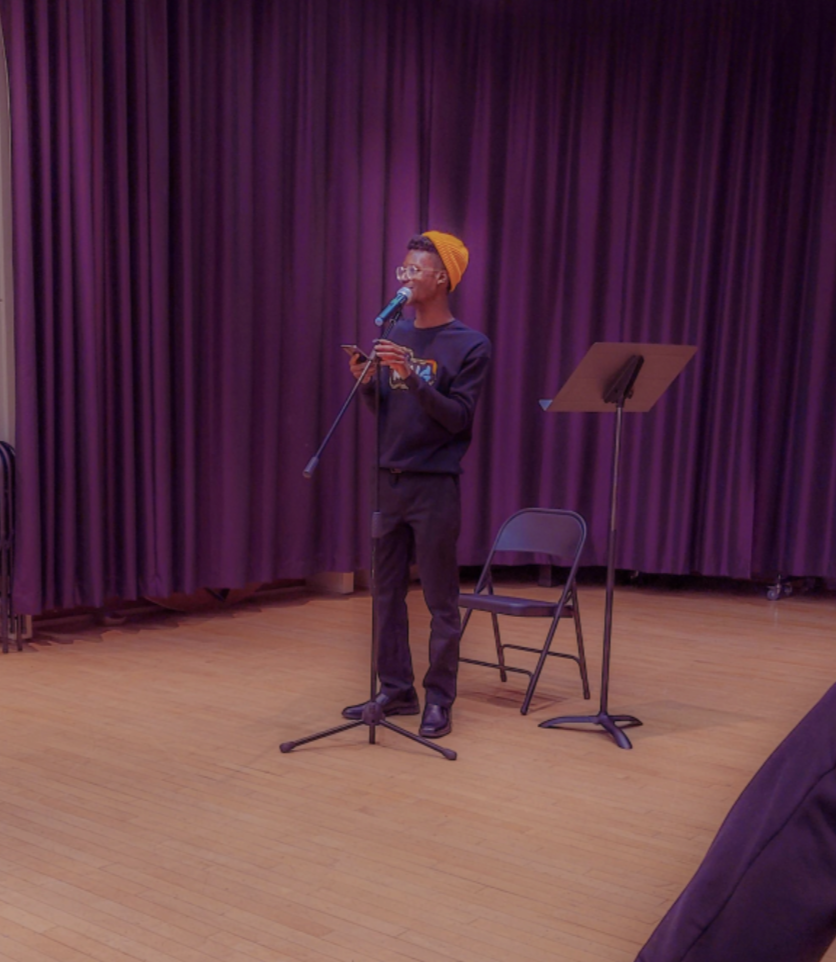
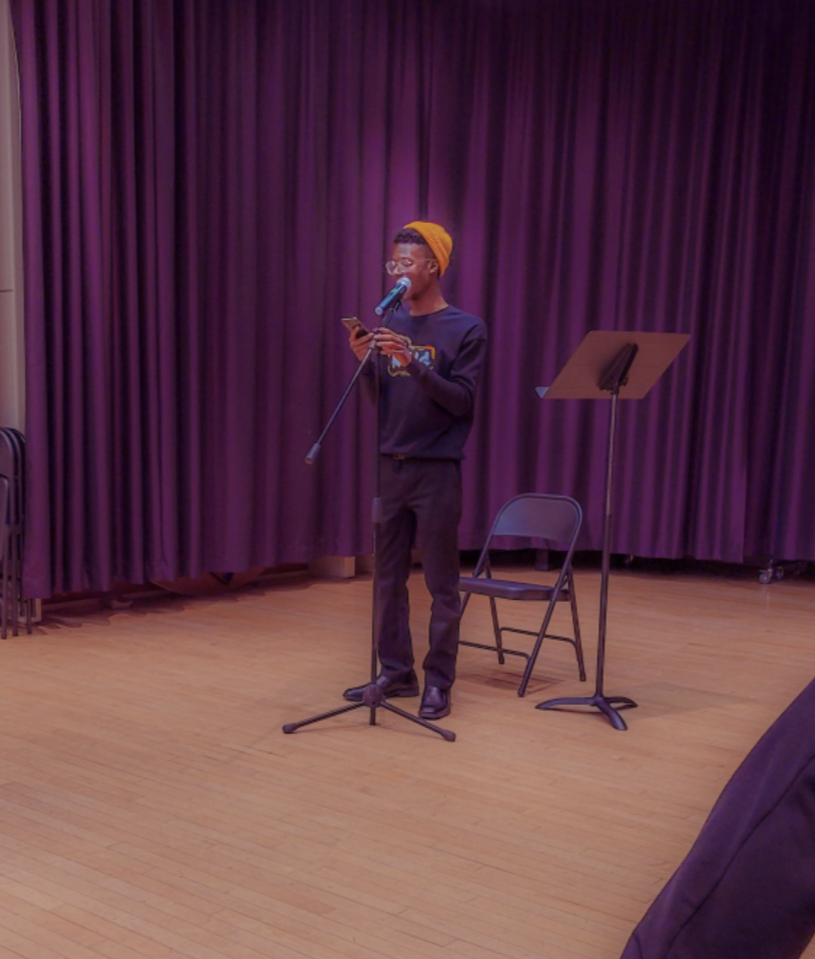
    As Martin Luther King Jr. week approached its end, the Cornell community found such a space. On January 23, students and faculty gathered in Zamora’s Lounge to honor the reverend and activist in an Open Mic Night. The event, hosted by the spoken word club Lyrically Inclined, the Black Awareness Cultural Organization (BACO) and the Office of Intercultural Life, encouraged attendees to participate in whatever ways they felt comfortable, whether that was by speaking or listening. A number of students took the stage throughout the night, sharing their poetry in an intimate yet electrifying setting as audience members hummed and snapped their fingers in praise. From reflections on modern-day political activism and the Pledge of Allegiance to the meaning of hope, the spoken word covered a diverse range of topics from people of all different backgrounds, experiences, and perspectives.

    The event welcomed alum Henry Morray ‘23 as its host. During his time at Cornell, Henry served as president of Lyrically Inclined, vice president of BACO, and coordinator for International Student Orientation/Each One, Teach One. To collaborate with these three groups again, he says, “was an absolute honor and privilege.” As host, Henry performed a number of poems at the event, one of which was familiar to many. His poem “The Afrobeats of My Heart” made its debut at the MLK Jr. Open Mic Night and Culture Show in 2023. It was inspired by King’s sermon “Loving Your Enemies” and his speech “Drum Major Instinct.”

    An open mic allows speakers and listeners alike to inhabit a collective space and exchange thoughts and ideas, emotions and truths. For Cornell to offer spaces like this is incredibly needed, especially during such a polarizing time in this country’s history. “The irony of the inauguration falling on MLK Jr. Day did not fall short on me and my peers,” Henry said after the event. “If King was alive today, I’m convinced that he would not shrink from the adversity of the times. Instead, he would stand tall against injustice and tyranny.” Such an act would not go unchallenged by the current administration, but this just serves as a reminder that our voices – all of our voices – hold power.

    “Truly the most valuable part of this event was listening to Cornellian students and hearing their powerful voices,” Henry says. “I’m very grateful for the vehicle that is spoken word and poetry, which transported and oscillated our drifted and anxious minds in and out of the past, in and out of the future, and into the present moment, into a collective catharsis.”

  • A Blue-tiful Day for War: Joe Goodkin’s The Blues of Achilles Performance By Emma Shipley

    On March 4th, 2025, Cornell College welcomed Modern Bard, Joe Goodkin, to campus. Armed with a guitar, lyrical slideshow, a degree in Classical Studies, and a desire to share his music inspired by Homer’s The Iliad, he performed an instrumental love letter that recounts the story of the Trojan War. His performance “evokes the original oral tradition of epic bards that stretches back millennia and frames the poem in an accessible way…for modern audiences” (Bowdoin College). The album of the Blues of Achilles involves 17 songs, all performed by Goodkin and produced with Steve Albini. Goodkin himself graduated with his classical degree from the University of Wisconsin and has since been performing all over the world and on many college campuses.

    This interpretation of The Iliad was striking in its ability to convey moments of love, grief, and anger. Each song had so much thought and care put into every lyric that left a mark on the audience’s hearts. The most distinct ones were the songs about love: a mother who loves her son and wants him to live a successful legacy, Achilles and Patroclus whose love transcends death, the brotherly love between Agamemnon and Menelaus. Even if someone only knows bits and pieces about The Iliad, these songs truly allow listeners to understand what is going on and be able to easily follow along with the story.

    Having loved the Percy Jackson series and How to Train Your Dragon–both forms of media that dive into Classical and Nordic mythology–my knowledge of the different stories that follow these divine beings is reasonably large. I have taken classes about different Greek customs, beliefs, and myths that have influenced my desire to continue learning about as much as I can. I am inspired by Goodkin’s rendition of The Iliad and believe that it could inspire a potential game (or a better, well developed movie/ television series) following Achilles and Patroclus during the war. There are a lot of interpretations of the book and it would be cool to add one more interpretation to that list.

    Since coming to Cornell, I have fallen in love with a lot of areas of study. While I am currently studying Creative Writing and Art History, this has stemmed from my love of storytelling that comes from understanding these myths. The details etched in stone and carved in marble has always had this influence on western culture and has inspired modern interpretations like Percy Jackson, Disney’s Hercules, and the God of War video game franchise. It has even inspired me to continue working towards my writing degree to pursue screenwriting. I am excited to meet Rachel Yoder, author of the book Nightbitch, and learn about what it takes to become a screenwriter when she visits campus on April 1st.

  • Rachel Yoder Lunch by Isabella Leo

    Hello everyone! My name is Isabella Leo and I am a budding junior attending Cornell College, impatiently awaiting my graduation in May of 2026. My future aspirations, branching from my Creative Writing major, are to become a published writer in non-fiction stories, poetry, and research, or even producing my own film(s). I am working my way towards my goal by staying involved in clubs at Cornell, such as being the President of BOOM Magazine, the Public Relations for Lyrically Inclined, alongside my submissions to SLAB and Open Field. Through Cornell College’s courses I have been able to explore and expand upon my future goals, an example being through my Advanced Memoir course with visiting author Jeanna Kadlec. In such courses I learn how to properly expel my emotions and explain my interests through learning about the quota of the publishing industry and writing process as a whole. My love for creative work and self-expression is spread throughout my being, and the joy I find in understanding myself and expanding my knowledge is found in everything I do at Cornell.

    I sat in on the lunch with published writer, Rachel Yoder, on April 1st in the Ringer Dining Room. From coming to this event I learned a lot about Rachel Yoder’s book Night Bitch and the process in creating it alongside its movie production. This event acted as an open opportunity to students and staff to learn about the industry and what being a writer can truly be like. Rachel Yoder answered every question carefully and tackled topics in connection to struggling as a first time mom when writing the book, how much she contributed in the films production–as she is not the one directing or who had taken charge of its creation–, the gap between writing a novel and scriptwriting, and much more.

    Through attending this event I acquired many valuable writing tips through our discussion that I intend to incorporate into my future works. A prominent point of discussion being script writing in comparison to novel writing when students asked her thoughts on someone else making the Night Bitch movie. Rachel stated that the movie adaption is the artist’s own story, her personalized image and art piece, part of a completely different world. Script writing is more poetic in nature, holding an abundance of imagery, maximized dialogue, and elaborated voices presented through emotional energy. To write a script is to animate the moments that were previously written, to flesh out every last detail. In writing the script you acknowledge the audience’s view compared to the novelist who does not think about their audiences, instead thinking about themselves and their emotions during their writing process. This point stuck with me as it made me realize that script writing is something that I may be good at as I hold a love and longing for poetry. Even though there’s a gap between script writing and writing novels, there is an audience that the author is reaching out to, an audience that I now long to reach in every way possible.

    The discussion at this event also ties into a class that I had taken earlier this school year, Memoir with visiting author Jeanna Kaldec. In the course we covered the lengthy editing process and publication, which ties into what Rachel Yoder had discussed. In addition, this lunch holds a close resemblance to upcoming courses, ENG 365: Literature and Cinema taught by Sam Walker in block 1 and ENG 377: Topics: Screenwriting with a visiting professor, Jack Messitt in block 7. In these courses students will learn about the difference between basic novel writing in comparison to writing for a film or play, whether that be through investigating film societies and literary coteries of the early twentieth century or creating a short film. So, make sure to look out for these courses if you are interested in anything that Rachel Yoder discussed in terms of screenwriting and adaptations!

    I have the dream, no, the goal, to become an accomplished writer and even experiment in film production. So, the discussion at this lunch provided me with helpful advice concerning the production industry in ties to the process behind creating a novel, both the steps within the business and editing portion and the emotional drawls/releases. From attending this event I now know more about the daunting process, feeling more well-equipped to lead into such a career and expansive projects. In connection to my future career goals in writing, there are the upcoming writing events on Cornell College campus that I know will inspire me further towards my literary future. A couple upcoming events that I am looking forward to include the ‘English and Creative Writing Awards Night’ on April 30th from 6:30 to 8:00 PM in Hall Perine and the ‘Last Free Write Friday & Poetry for Obsession Chapbook Release Party on May 2nd at Van Etten Lacey House. It has been such a great school year and as the new year is treading on I cannot wait to celebrate, collaborate, and communicate with Cornell’s writing community at these end of the year events. I toast for us to forever be creative and never doubt the greatness of our writing, to express ourselves beyond our imaginary confines within our minds, and grow from our writing! Thank you Cornell literary community!

  • The West by Varun Ramrakhiani

    My name is Varun Ramrakhiani, a foreign student of an American college, at a time when America and her allies are perpetrating horrible crimes upon a defenceless people. Omar El Akkad’s new book is partly about this experience. One day everyone will have been against this, it is an incredibly important book for those of us not of the west, stranded in the west, for whom the west appears aberrantly wild and without concern for the world. To people like us, all the values of humanistic education seem to us as if somehow grand lies are perpetrated to mask fundamental realities of murder. Who would read literature and philosophy at a time like this, when all the premises of civilization are being to wantonly violated and disregarded?

    El Akkad articulates the reason for writing the book in terms that can be generalized to anyone living in the west. The experience he describes does not require heritage from the third world, some lived or told insight into the plight of the dispossessed. Rather the experience the book is about is one of being audience to the horrific, obscene and gruesome, through screens and the funnel of information economies, through the ostensibly invisible mediation of news channels and social media outlets. The concept relies on the characterization of the audience being a fundamentally passive entity, for whom all the events of the world, history itself, appears as a ceaseless stream of decontextualized data which cannot be assembled into coherent narratives that mobilise and empower. Instead they create victims of history and spectators of history, making all the crimes of all the world seem inevitable. Of course this is not the only experience. There are a great many people in the west trying to stop the genocide in gaza, stop the american goverment’s uncritical enablement of Isreal, but not nearly enough and these attempts have not been very successful. On the part of these very brave actors, the title of El Akkad’s book seems like a terrible omen. One day everyone will have been against this. The very simple truth is, this is all preventable, so many people do not have to die, do not have to flee, do not have to be shot and maimed and ripped apart by shrapnel and bombs, do not have to plead for help that will not come, do not have to fight for a humanity that is denied them. History is not inevitable.

    The language in which history is written, in which the spectators immortalise the victims, El Akkad points out today is the language of liberalism. The political project of the west, the preservation of which defined the cold war, the two world wars and the unnumbered proxy wars of modern history, is today the system that enjoys uncontested global hegemony such that itself is used to justify the crimes in Gaza. It should not be surprising then that people like El Akkad think the project has failed, has not lived up to the promise of the enlightenment, or whatever mythology we impose as the founding narrative of our world. But it is shocking for societies like America to hear that El Akkad simply does not believe in what you may call the American dream, the liberal world order of rights and the institutions meant to protect these rights. The imperializing culture of the west cannot see past its own nose, is addicted to its own self image as the arbiter of the rights and privileges of nations and people, and so retreats into a daydream of its democracies and institutional procedure, such the basic barbarous reality is concealed, cannot be apprehended,is always mystified into an image among a million images. This is the ancient marriage of civilization and barbarism, of murder and humanity.

    I remember reading Fanon in Megan Altmans class, about the very phenomenological structure of the master-slave encounter, which already has the specter of violence as a realizable possibility, that violence is somehow in the air at the very sight of the colonial subject, the subject’s basic existence necessitates it. I wonder about how this basic experiential structure must be interpreted by the culture of imperial society to be justifiable, to normalize it in the very language that courts use and presidents use to punish the villains of this or that crime. I wonder, looking forward to further study in the west, how to navigate my very visceral feeling about these events, my very unaccommodating and accusatory view of the cultural discourses of these places, into my actual conversations with people of the west. I find it an impossible situation, without a comfortable resolution, that only further estranged me from everyday life, makes me feel that belonging here will always be impossible.

  • BOOM’s Zine Workshop by Bianca Rodriguez-Oquendo

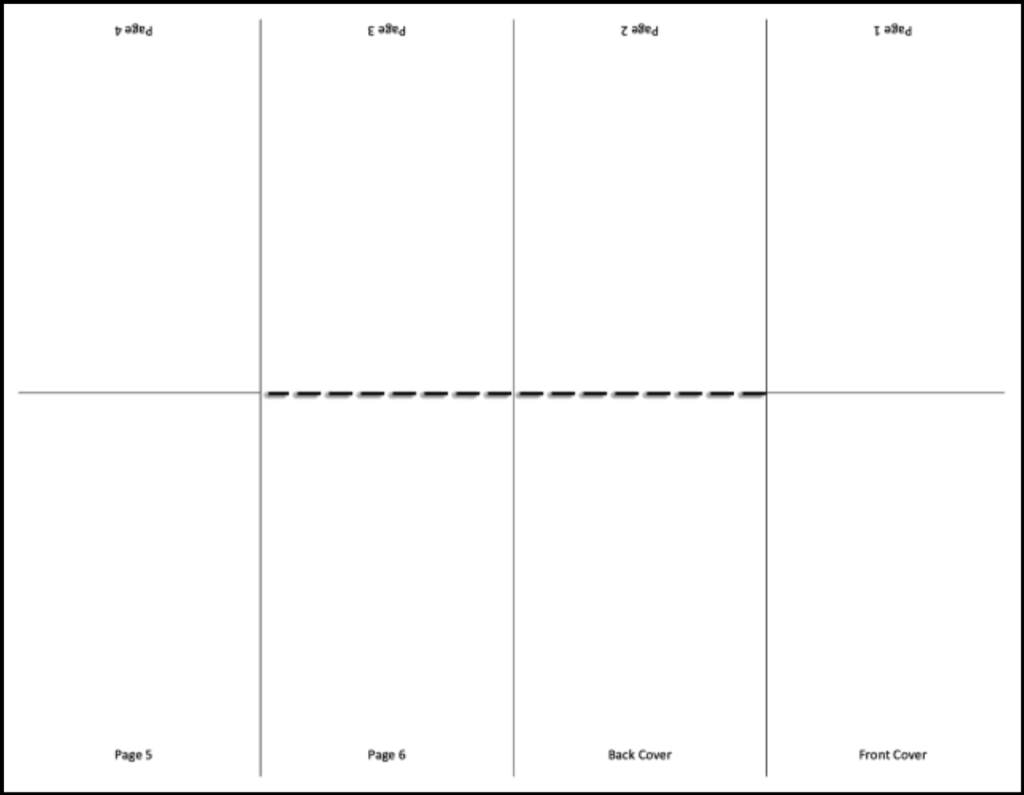
    Led by Professor Scott Russell Morris, catered by Bon Appetit, and hosted in our beloved Zamora’s Lounge, BOOM—one of Cornell College’s student run literary interest groups and magazines (President Isabella Leo ‘26)—workshopped the creation of zines. As a junior majoring in Creative Writing, and a lover of crafts, I eagerly participated in the workshop alongside many of my peers from the English Department. Professor Morris introduced us to the history of zines and their diverse forms, and as we were being taught how to make our very own, we were given two sets of instructions from where we could choose the style of the zine we wanted to create. Students could also choose whether to make physical zines with recycled magazines, old books and other art materials, or to make them digitally.

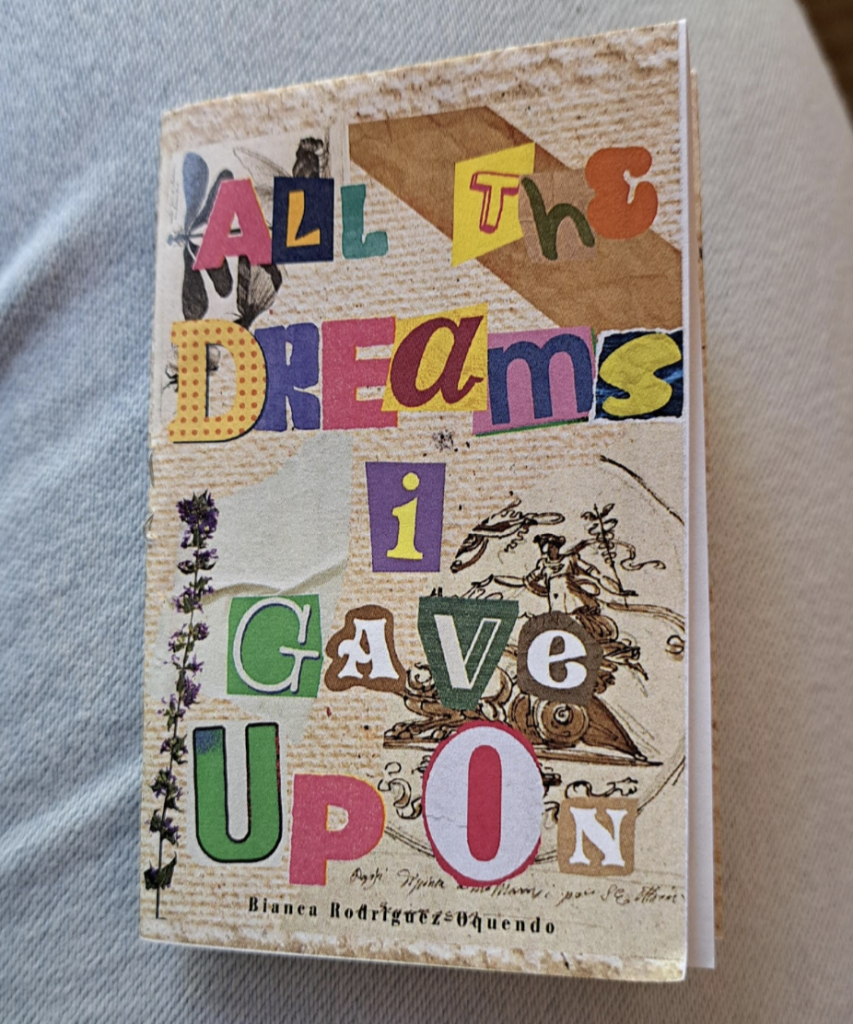
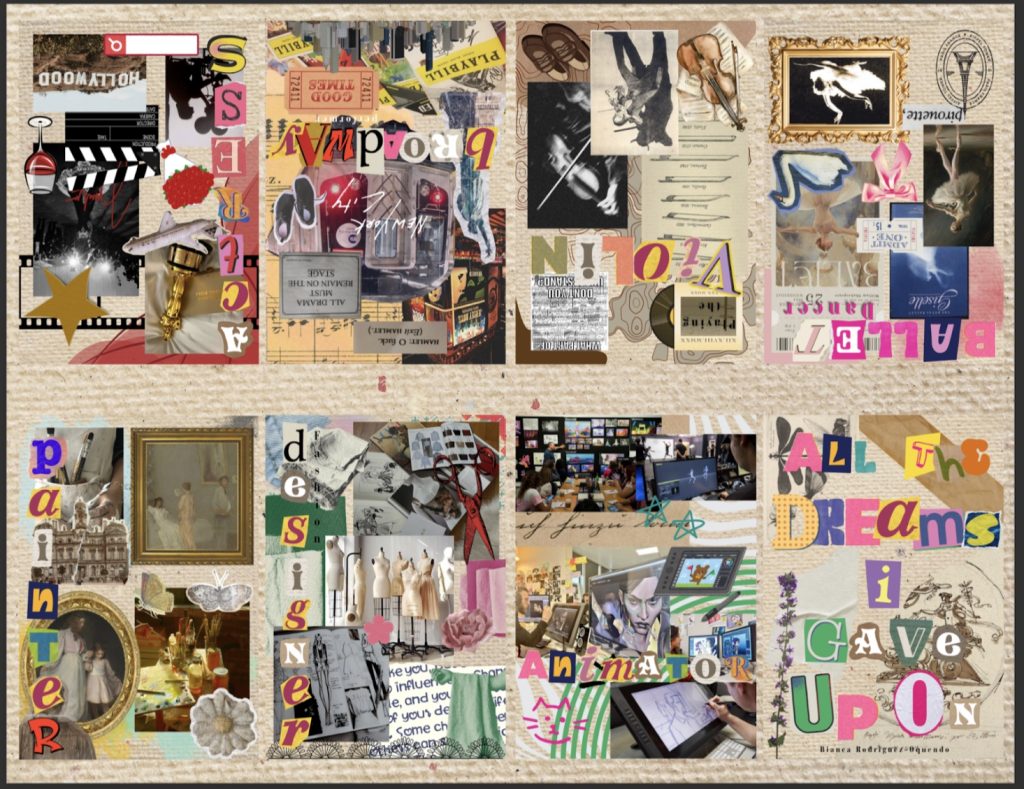
    I was personally inclined to create my zine digitally using Canva and getting my pictures from Pinterest. Although it made the possibilities greater, I had no idea what to make my zine about or where to start. I had not really thought about it prior to the event, but then the contemplation of creative dreams led me to the final product (which took around two days to fully finish). Zines like any other creative outlet are modes of self expression, ranging from social and political statements to short illustrated stories. I was far from unfamiliar with them, having made one during an art class years ago. This thought reminded me of my childhood and all the creative things I had tried or dreamed of, and encouraged me to make my zine about the creative dreams I had given up on as I grew up. Though the concept seems sad, each page of my zine was a representation of how I still picture these dreams. They are all a part of me and who I am even if they are things I now prefer to admire rather than do. 

    Screenshot

    The creation of my zine was a healing, relaxing process, highly detailed and purposeful. I had a story to tell without words; I could finally put to rest that which I thought was lost or made me think I had failed. I titled my zine “All The Dreams I Gave Up On”, but opposite to what the bitter name of it might seem to imply, I rather think about it as growing above my childhood dreams and finding—thanks to them—the things I truly want to do for the rest of my life. I believe that creative events like these can help people find the encouragement they need to express the things they might otherwise be unable to with their voice. It is my hope in the future to workshop crafts like this one back home in my community, where arts like these lack.

    I encourage you with this, dear reader, to make your very own zine.

  • Journeys and Jewelry by Maggie Helland

    My name is Maggie Helland and I am a Senior at Cornell College. As a Digital and Multimedia Writing major, I have been very intrigued by different mediums of art, including jewelry making. The Cornell College community allows for creativity to shine, and they love to showcase art made in the community and its artists. One of my favorite art festivals to attend in Mount Vernon is the Lincoln Highway Arts Festival.

    I absolutely loved attending the Lincoln Highway Arts Festival this year. I have been in years past and I always love to see the beautiful works of art that people in the community have created, and I love to hear the stories behind their works.

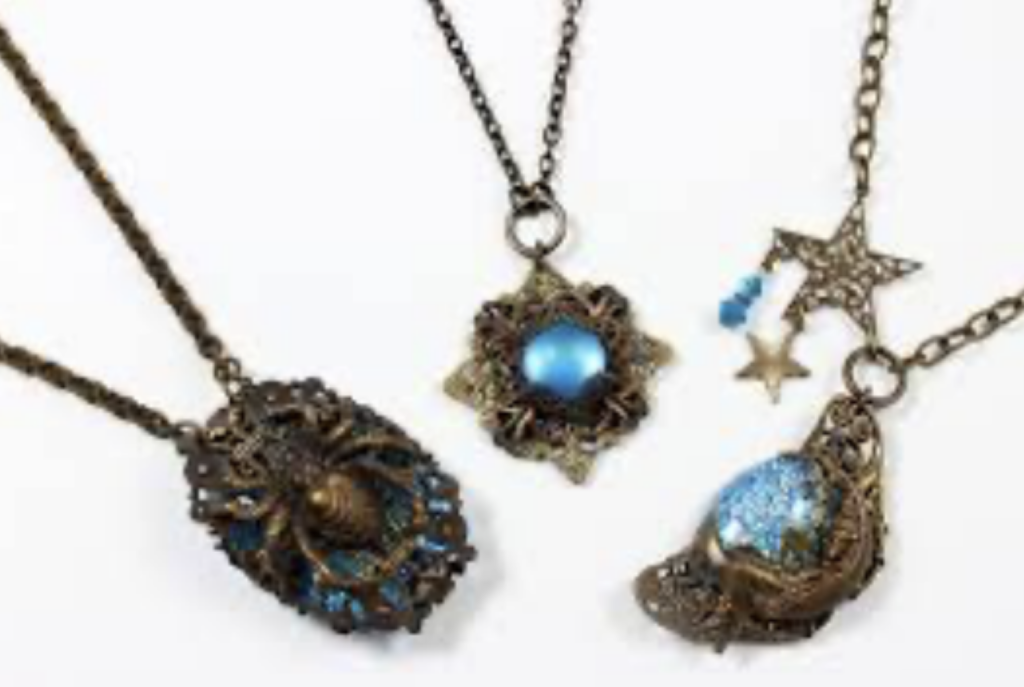
    A couple of years ago, there was a woman selling her jewelry at the festival. Her name is Connie Rodgers and her pieces immediately caught my eye. I had never seen anything like it before and it struck me, leaving me with a feeling that I needed to have one of her pieces. I spoke with her and she told me of her travels all around the world to find pieces of metal and glass that she then uses to make her jewelry pieces.

    Connie Rodgers, Art on the Prairie

    She had a certain whimsy and way about her that was very much alive in her art. I was lucky enough that she was back again this year and I finally bought one of her necklaces. As someone who would not consider myself an art connoisseur, finding pieces that speak to me deeply is one of the greatest feelings. I am so happy to now have one of her pieces, and I am proud to wear her beautiful creation.

    Connie Rodgers, Art on the Prairie

    Looking ahead towards a career path, this festival always reminds me that people really are out here living their dreams and making art that means so much to them. Sometimes, I am weighed down by the feeling of needing to have everything figured out, but when I walk through the booths and hear the artists talk about their journeys, I am reminded that life doesn’t have to move in a straight path.

    I think about my own goals, how I want to become a flight attendant and see the world, but also how much I would love to write about those travels, maybe through a blog or even a book one day. The festival reassures me that I don’t have to choose just one path or confine myself to a single identity. Creativity can be something I carry with me, no matter where I am or what my “day job” looks like.

    Even if I am not creating traditional art, I can still live a creative life through storytelling, through capturing moments in writing, and through the way I approach the world. The artists at the festival inspire me to believe that it is possible to build a life where I can do both: pursue a career that fulfills me while still making space for the things that light me up creatively. It’s acomforting reminder that passion and practicality don’t have to be separate, and that my future can hold more than one dream at a time.

  • The World of Slam Poetry by Emy Taylor

    Poetry has always been a huge part of my life on campus. As an English major with a Creative Writing concentration, and as the current president of Lyrically Inclined, Cornell College’s poetry club. I find myself writing, listening, reading, and engaging with poetry often.

    It’s always a treat to go to an open mic, especially in Iowa City, a UNESCO city of literature. Slam-O-Vision only elevates the experience. In slam poetry’s very own Eurovision, cities from all over the world host competitions and send a video of the winning participant’s poem to a final round.

    Sign your name onto a first-come, first-served sheet, and you become a participant in this global competition. It starts with a three-round structure, with a limited amount of time for each poet. If you go over, you lose points. Guests, picked randomly from the crowd, are asked if they have a connection to a competing poet. If the guest claims no connection, they receive the special job of judge. With five judges, the Slam-O-Vision organizers drop the highest and the lowest score to calculate if you make it to the next round.

    The performance for round one takes the longest, as the most participants remain in the game. They start with a sacrificial poet to help judges get used to the practice, as it’s common for the first poet to get the worst score. It’s often the emcee, or the previous year’s winner. For my performance personally, I was 0.1 away from making it to the second round. You live, and you shrug.

    Depending on the number of poets in the first round, the second round makes sure to cut the size down. A shorter round, but now with the stakes more glaring than ever, the judges and the poets are very aware of the scores they give. The crowd is encouraged to say “Higher!” if they believe a judge has scored too low and the energy is electric. The variety in poets and poems becomes obvious as they share more of their repertoire. It’s dizzying, exciting, and makes your hand twitch to write more of your own.

    The final, third round of the event leaves us with four finalists. The four finalists try to share the best of their poems here, as this is the poem that moves on to the global round. This can be difficult because they may have used some of their greater works in order to make it this far. It’s a strategy game in some regards, but the best final performance wins it all. For this year, it was alumni Henry Morray who took the win. This was his second time winning for Iowa City, with a few years in between.

    While the night ends after the third round, the competition continues. Competing cities include Dublin, Ireland; Manchester, England; Vilnius, Lithuania; Tartu, Estonia; Melbourne, Australia; and many others, alongside, of course, Iowa City, United States. Scoring 218 points, a whopping 34 points above second place, Henry Morray went on to win globally as well.

    As a previous president of Lyrically Inclined, Henry Morray’s resounding win was wonderful to watch. Poets, of all kinds of differences in experience, some who tried out the stage for the first time, contributed to the amazing energy of the event. The structure of a competition, the change in scenery, and the unique mix that is Iowa City’s poetry scene led to an enjoyable and inspiring evening.

    As someone who hosts the majority of our open mics on campus, I’m always looking to improve how we handle them. I enjoy seeing how events like Slam-O-Vision are handled and how organizations differ. In 2023, I had the pleasure of interning for Chautauqua Writers’ Center. While there, I participated in several open mics. These events took place outside, and as a result, we were often joined by those passing by. There was also zero competition involved and no sign-up sheet. To share your poetry, or for some,
    read someone else’s, you simply raised your hand when they prompted for the next poet. It was a free-flowing environment that led to a lot of interaction between guests. You had to pay attention to who else may be interested and gauge if there was a space to share again, if you wanted.

    Lyrically Inclined’s open mics fall closer to Chautauqua’s than Iowa City’s Slam-O-Vision. While a sign-up sheet exists, when it falls short, there will be a break to grab refreshments and chat as the sign-up sheet fills up once more. This allows people multiple turns, if desired, as well as time for some to build the courage to perform. All three styles have their pros and cons. As a senior, the variety helps me consider how I might want to continue interacting with open mics, and poetry, in the future. As I leave Cornell’s campus, and most likely Iowa City’s vicinity, behind, it’s important to consider where and how I might want to interact with open mics next. I could also make the move to switch to page poetry circles. There’s a lot to consider. As I move on, Slam-O-Vision, my first open mic as a freshman, will always hold a special place in my heart.

  • The Importance of Activism by Ava Devaud

    Hello! My name is Ava Devaud. I am a double major in Creative Writing and Behavioral Neuroscience. Serving as President of SLAB after three years on its executive board, working as an RA for the past two years, and conducting research in the Integrative Neuroscience and Behavior Lab under Dr. Steven Neese has provided me with opportunities to challenge myself, learn from others, and grow in unexpected ways.

    I have been lucky enough to have the opportunity to live and study abroad not once, but twice—first in London two years ago, and most recently in Barcelona this past spring. Immersing myself in these new cultures and academic environments has profoundly shaped how I see the world and my place in it. Balancing multiple passions and responsibilities can feel overwhelming at times, but I have learned that embracing challenges—whether in the humanities, the sciences, or in life offers the most meaningful growth. Cornell has provided the guidance and resources to navigate these experiences, and I am grateful for the ways it has helped me build both confidence and a strong foundation for the future.

    As part of the English major—regardless of the concentration a student chooses, whether in Multimedia, Creative Writing, or Literature—students are required to take ENG 515. This course is designed to immerse English majors in the literary community, encouraging them to engage in meaningful work while reflecting on their experiences. Rebecca Entel, who supervises the adjunct course, also acts as a mentor by creating opportunities for students to connect with the literary community. She keeps an up-to-date calendar with dates, times, and locations for events that students can attend, participate in, and later reflect on. These reflections are shared with Rebecca and, eventually, with the wider Cornell community through a blog post.

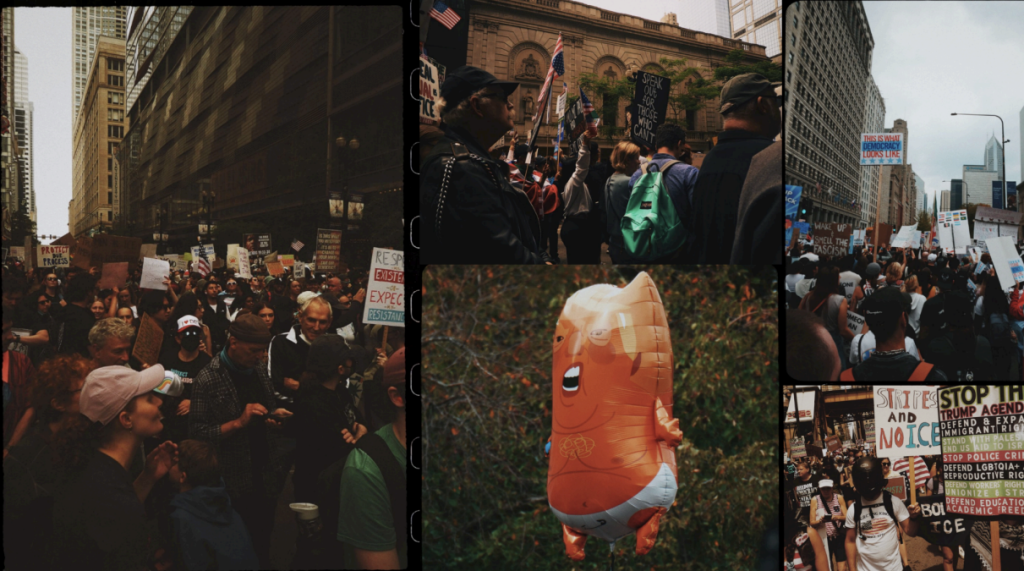
    As I was scrolling through the calendar for ENG 515 events, I came across the No Kings Protest. Seeing it listed felt like more than just an opportunity to fulfill a course requirement—it resonated deeply with how I see myself as an activist. For me, activism isn’t only about speaking out; it’s about showing up, walking alongside others, and contributing to something bigger than myself. Attending the protest gave me a chance to reflect on my values, my role in a community, and the ways I can act on my convictions. I chose to document the experience through photography and poetry, capturing not only what I witnessed but also how it felt to be present and engaged in that moment.

    The No Kings protests took place on October 18, 2025, as part of a nationwide movement opposing Donald Trump’s policies and actions during his second term. Building on earlier protests from June 2025, the October demonstrations occurred in over 2,000 locations across the U.S., including major gatherings in Washington, D.C., Chicago, and New York City. I attended the protest in Chicago, Illinois, with my mother. I have participated in protests for various causes—from pro-choice and anti-ICE demonstrations to defending our democracy—because I believe it is vital for citizens to stand up for their rights. As a woman of color, born in Central America and fortunate enough to obtain citizenship, I feel a responsibility to stand up for those who cannot. I chose to reflect on this experience by writing a poem about being condemned simply because of my skin color, about wanting equality for all, and about how the fight can be exhausting, yet is sustained by the solidarity of others like me.

    As a senior, I am currently applying to master’s programs in Biomedical Sciences and Pharmacology, temporarily stepping back from the humanities—but not abandoning them entirely—to pursue my passion for healthcare, a field where activism and humanity are urgently needed to improve patient care and outcomes. The protest moved me deeply and strengthened my commitment to showing up—tired, hungry, sore, and bruised—not just as a citizen in theory, but in practice. As I approach the end of my final fall semester, I am grateful and honored to have taken this adjunct course, to have participated as a literary citizen, and to have documented a moment in history that will not be forgotten. I will always be a reader and a writer, no matter where my path takes me, and I will continue to document and share, ensuring the world knows that someone is out there listening—and acting.

    PEACEKEEPER By Ava Devaud

    But I was born carrying it—
    this skin, this story,
    this ache that asks for nothing
    but to be seen as whole.

    They look at me like I am a warning,
    like love should come with conditions.
    And when I ask for equality,
    they call it trouble,
    as if peace was theirs to give,
    as if peace was theirs to withhold.

    I get so tired sometimes.
    Tired of being proof,
    tired of being patient.
    The world keeps asking,
    demanding, begging,
    asking for calm,
    from the ones who are burning.

    This heaviness hums under my ribs,
    tension building bit by bit,
    until my ribcage feels too tight to breathe.

  • The Letter by Charley Coleman

    Hello! My name is Charley Coleman, and I have a major in Creative Writing. While there are many different English Department activity groups available on campus, I enjoy the independence of the major. Even though I work mostly independently, there is a strong writing community here at Cornell, and that has helped me reach outside my comfort zone in sharing my work.

    I started this year off with a Vacation Block, and while some students may see that as a time to relax, I knew that I needed to utilize this time to start creating a writing schedule for myself that I could stick with throughout the year. With the ENG 515 course, Literary Citizenship, there is also a monthly calendar that is released with in-person events and various readings that could be beneficial to those in the writing community on campus. While I knew I wasn’t going to be able to attend the in-person events on campus during my time at home, I knew I could use this remote learning experience as a way to get back into writing. Each semester of ENG 515, we are allowed to have up to eight hours of creative, personal writing, and I knew that I would have to utilize this to my advantage, being remote for the first block of the semester.

    With specific goals in mind, I began to create a writing schedule that would work with both my school and personal life, knowing there were going to be multiple transitions on and off campus. During this first block, I made notes on specific areas in my novel that I could begin working on. In previous years, I tended to just jump around in different directions, leaving multiple unfinished pieces of writing and figuring out how to connect them all. This time, I used my past experiences to try a different course of direction. I began to draft a version of the prologue, hoping that starting from the beginning would make it easier, but somehow, it was just as difficult. I kept hitting writer’s block and did not know how to continue forward without feeling like I was making no progress. At the end of this first block, after experiencing many writer’s blocks, I had a decent draft of my prologue and the direction I wanted my novel to go in.

    With the transition back to campus in block two, I took this time to get back into the swing of campus life. I did not write as much as I had hoped at this time, but looking back, the break helped my writer’s block tremendously. While I wasn’t actively writing my novel, there were times when I jotted down notes on what to work on next, giving myself multiple options to choose from for when I did start writing again.

    In block three, I was allowed to take an Independent Study course, focused and structured specifically around the creation of my novel, “The Letter.” Professor Rebecca Entel and I came up with a small list of goals to achieve during this time. Shortly after, an occurrence of multiple personal events came up, and this would cause me to make drastic changes to my writing goals. Looking back at all that has happened so far this year, it has made me realize that not everything is going to go according to plan. From a writing perspective, these events and changes in my original plans helped me realize what did and did not work in my creative process. Having scheduled times to sit down and write proved to be the most helpful in terms of motivation because it gave me a chance to escape from reality and dive into the world I was creating.

    Overall, I took advantage of these four blocks of the semester. I was able to experiment with different writing environments, as well as different emotional approaches to specific scenes and characters in my novel. Moving forward, I would like to attend more English Department activities, such as FreeWrite Friday, in hopes that I will be able to branch further outside of my comfort zone. Here is a draft attachment of the prologue for my novel, “The Letter”:


    Prologue

    The First Letter

    Sawyer, (and if your name is NOT Sawyer Kinkade and you are reading this… move along, or else. I mean it.)


    I’m so sorry, Sunshine. Losing your grandfather, and now me.


    But what did we expect, right? We both knew I wasn’t going to last without him. He was the love of my life. The light in my darkness. He was the other half of me. I hope you’ll be able to find that in your life sometime, even when it seems like it’ll never be possible. But who couldn’t love you? You’re a bundle of joy. My Sunshine. Hell, it’s been about twenty years since he passed, and I’m still here. Well…not really
    anymore, considering that you’re reading this letter. I can’t reveal too much in this first letter, in case someone intercepts it before it gets to you.


    Okay, back to what I’m actually supposed to talk about. Somehow, I still ramble on paper as if you were here with me while writing this, but you aren’t. I’m writing this because I have a feeling that…
    and…here I go again with my rambling. Okay, seriously, game face is going on.


    You need to listen to me, it’s important. Code shimmer, it’s that important, are you reading me right? (you know, since you can’t hear me, haha). There are certain things you don’t know yet, and this letter is the way I have to tell you. As difficult as it’s going to be to understand everything through the letters, you will learn that the Kinkade family has a secret that has been passed down through generations. I could never find the right time to tell you the truth in person, part of that being that I wasn’t ready to tell you, not because I didn’t think you were ready. The responsibility of this secret needs to be guarded by your life, literally. I’m not kidding, and I have a feeling that it will cost me my own, like the many others before me. And now it’s time you finally understand the meaning of being a Kinkade. You’ve always been a smart woman, even as a young kid. So I know you can figure out the truth and arrange the pieces the way they are supposed to be. The pieces have now fallen into your lap, darling. There are a lot of people, horrible people, in this world who have been trying and will continue to try to reveal this secret. They can’t. Ever. Do you understand me, Sawyer? When you learn the truth, keep it to yourself. No matter the costs.


    Trust nobody.


    Along with details on you finally being the keeper of the family secret (it sounds as daunting as it is, trust me), there are other details to discuss.


    The diner. I know it has a special place in your heart. It does for me as well. I’ve watched you grow from a child into a beautiful woman. You don’t take anyone’s shit, and that’s one of the many things I love about you. I also know that it isn’t what you want to be doing with the rest of your life, running the diner, so my attorney will be in contact with you once I’ve kicked the bucket officially. And, yes, I’m cracking jokes about my upcoming death, sue me. Oh, wait, you won’t be able to ;). You guys can discuss the next course of action for the diner, whatever it is you choose. I just ask one thing. Don’t let it get torn down. Remodel it and turn it into something, but don’t tear it down. It’s more important than you think.


    Besides the diner and obviously the house, there is one other piece of property you are unaware of. There is a cabin that lies in the woods on the back edge of the property, by the cliffs. We never brought you there or discussed it around you because of the dangerous and mysterious lands. It’s part of the Kinkade secret. It has been a part of Grandad’s family for many generations. You’ll inherit that from the will as well, just be cautious.


    To sum it up, you are inheriting the diner, the house, the cabin, and all the property I own in town. And I know you’re probably freaking out; it’s a lot. But take your time, sweetie. There is no rush. A lot of memories from your past, and some of mine, are going to be brought forward. Some you may remember and some you may not. It’s going to be a lot all at once, but I know you’ll make the right choices. We never had the opportunity to discuss what you wanted to do with the diner when you were to inherit it. And here we are, me communicating to you through letters after I’ve died, crazy. Huh, I guess Old Man Jim was right when he called me crazy that one time, haha. But anyway, I meant to have a sit-down
    conversation with you, but time just got the best of us. What I’m trying to say is, you can do anything you want, Sunshine. If you feel that selling the diner would be the best option for you, do it. Do whatever it takes to make yourself happy again.


    Besides the attorney, there is one other person who will be making contact with you once I’ve passed. He’s going to be handling the personal matters; everything has already been taken care of and paid for (for whatever situation is running through your crazy head right now). All you have to do is be there. For everyone else, but mostly yourself. You’ve dealt with loss, and it changed you in ways no one else will ever understand. You rise each morning and make the same trek down the stairs to the coffee machine, grabbing the same mug every morning. You carry yourself as if every day is a fresh start, opening the blinds to a new world of promises. From the moment you were born, you’ve had to fight. Not just because of your mother, if you even want me to call her that. With all the people that left, and things that changed with time, you absorbed the silence; found peace within it. There has always been a light inside you. It has never gone out, no matter what events have been thrown at you. That’s why I call you
    Sunshine. I tried to get Spitfire to stick, but your Granddad fought against that one. Guess who won.


    I know it’s going to be difficult, and I have a feeling you might shut down a bit after my death. But I need you to get up every morning and make the same walk to the coffee machine as always. Start with that, at least, and go from there. Some days are going to be harder than others, and that’s okay. Don’t use my death as an excuse. You’ve dealt with loss before, and you can do it again (yes, I’m being a bit harsh, but I want you to know that I’m only doing it because I love you). I’ve had the honor to watch you become the woman that you are today, and I couldn’t be more proud.


    Okay, I know by now you probably have a bunch of questions running through your head. Like, how did I know you didn’t want to keep running the diner? Who’s the random guy? Why did I never mention the cabin? But a magician never reveals her secrets, darling. Many things that will make shocking appearances, and you must trust your instincts on how best to handle them.


    Before I tell you anything more, I need you to promise me that you won’t leave Ashwood (for good) until after you sell the diner and look in the basement. Make it the last thing you do. Deal with everything else first, whatever it is. You have to promise me, Sawyer, even if I’m dead. Say it out loud.


    Promise me. Please. Say it right now.

    That’s the only condition: look in the basement. Yes, the one that has always been locked. That’s all I’m going to say for now; the rest you have to discover for yourself. The diner is linked to the Kinkades in a deeper way than I have been able to find so far; there are still missing pieces. Hopefully, with your fresh eyes, you’ll figure out the truth. Keep the truth a secret, no matter what you have to do. There are no lines or boundaries that people won’t cross; people will try and stop you from learning the truth. Their attempts will show you the gravity of the situation. People have been after the Kindkades for as long as I can remember, and it seems to be going in a horrible direction. People are preparing. People will get hurt. You also need to prepare. You must. But there is one thing you need to know.


    You can trust Ryker McKinley.


    I know, Sunshine. He hurt you. But he’s your other half. Like your Grandad was for me. He brings out the best in you; your smiles and laughs, especially the memories. When you guys were children, he left for a reason; one you didn’t and still don’t know about. Ever since the day he walked out on you, just know that he had his reasons, and yes, I do know them, so I’m not just saying it to get you to believe me. He’ll tell you when he’s ready, and if he’s not, don’t push him. He needs someone on his side for once. Not against him. He was there for you when you needed him most, no matter how much you hate to admit it.


    You guys loved each other.


    If he gets involved, don’t fight him. I’ve already told him all the details he needs to know on his side of this shit show, but now you know your information (or at least, the start of it. It was too dangerous and too much to explain in one letter. There will be others shortly.)


    Once everything (and I mean everything) is done and taken care of, you’ll have to make a decision. There will be a set of coordinates on the last letter you receive from me; you will know when it’s the last one. The coordinates aren’t marked on any plain map; the coordinates will go to a specific map, which is located in the diner’s basement. Until then, the map will be useless. But keep it safe.


    Your Granddad and I felt that keeping you tucked away in our small town, surrounded by the water and townspeople, was the safest option. It was secluded and safe, at least it had been for a while, until recently. My last wish is that we made the right choice.


    You are a Kinkade.


    Kinkades aren’t afraid. They don’t run away from their problems. They stay where they are and fight for what they love and fight for those whom they want to protect. Your mother was never a Kinkade, at least not fully. She wandered in and out of the town often, disobeying our parental orders and those of the authorities. At eighteen, she left for good. I never knew she had gotten pregnant with you until I got the call that night at the motel from your father. You probably don’t remember that night at all. You were just under a year old. You had already gone through so much, been through many dark times, at such a young age. You always had these fits at night when you were a baby, always from the faintest noise. You refused all soothing remedies; we tried everything. The only thing you did was cry. You would cry so hard that sometimes your face would turn bright red. I even called Sharell, the 911 dispatcher for the town, a few times because your Grandad and I were helpless. We didn’t know what to do. The way you entered this world shaped you into the woman you are today. Your mother had her reasons, no matter how insane and absurd they may seem. She made her choices, and you are allowed to make your own.


    When you’re ready for more secrets and information about your parents, you’ll know when the second letter appears. Don’t search for it, there’s no use. I have a system for how you will receive the letters; it may seem absurd, but it’s necessary.

    xoxo, Nana

    P.S. You will always be my Sunshine. I’m sorry you have to go through these next parts of your life alone. I wish I were there for you to help you process the information. But this is where you prove yourself. You need to do this for yourself. But also for your father. He’s depending on you. I love you.