What is Synesthesia?
Synesthesia is a condition where one kind of stimulus triggers an unrelated sensory experience. Put simply, an input results in a usually unrelated output. Synesthesia is most commonly experienced as a perception of color, like hearing them through music and sound. Keep in mind, however, that every experience of synesthesia is unique. Some people see colors from written and spoken words, days and months can elicit certain flavors, tastes and textures can trigger emotions, and many more variations exist. Synesthesia is argued to affect anywhere from as few as one in twenty thousand people to as many as one in eight according to EBSCO Information Services. The statistic most accepted nowadays is that around 1 in 25 people have some form of synesthesia.
There is also evidence to suggest that everyone has some degree of synesthesia, but it just tends to be a lot weaker in most people. There is a discernable difference, though, between the brain activity of a person with and without synesthesia. We don’t yet know why exactly this phenomenon happens, but there are a few ideas. There is a heavy genetic factor, but it also could be related to connections in the brain during infancy. It is possible that babies naturally mix up sensory information in their brains in a way akin to synesthesia. The usual development process untangles the senses over time, but it is theorized that those with synesthesia still have their senses tangled, possibly through genetic mutation. Synesthesia can also be developed after a brain injury or induced temporarily through hallucinogenics.
I created a painting by using the colors I heard in music as a way to better grasp what those with synesthesia experience. In order to create this piece, I took inspiration from artists who have or were suspected to have synesthesia.
Artists with Synesthesia
Vincent van Gogh
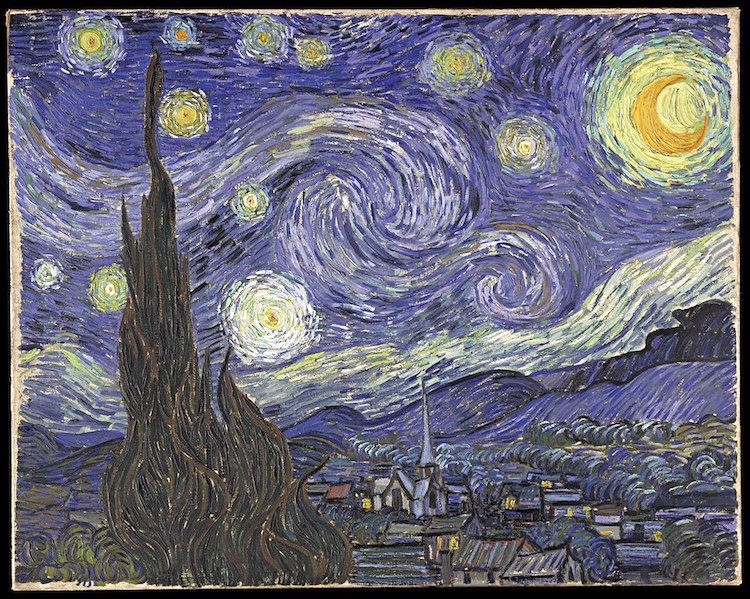
Van Gogh was a Dutch painter who lived from 1853 to 1890. While he may not have been diagnosed with synesthesia during his lifetime, there is evidence to suggest that he experienced it very strongly. He wrote letters to his brother, one in which he discusses something that certainly sounds like a synesthetic experience. He wrote, “Some artists have a nervous hand at drawing, which gives their technique something of the sound peculiar to a violin.” When he tried to learn to play the piano, he was unable to grasp it because he said every note evoked a different color, and the experience was overstimulating because of it. His teacher unfortunately took this as proof of Van Gogh’s insanity.
Wassily Kandinsky
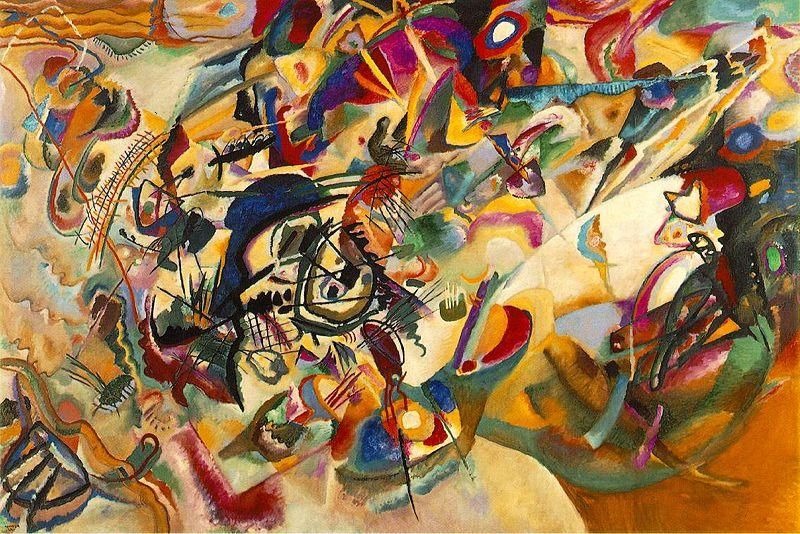
Wassily Kandinsky, a Russian painter who lived from 1866 to 1944, was one of the first to champion abstract painting in Western art. Music and color were, to Kandinsky, inseparable, even once being quoted as saying that “The sound of colors is so definite that it would be hard to find anyone who would express bright yellow with bass notes or dark lake with treble.” He painted a collection of abstract pieces that conveyed his sense of synesthesia by interpreting different notes and timbres as specific colors. Along with painting, he also expressed himself through playing cello.
Melissa McCracken
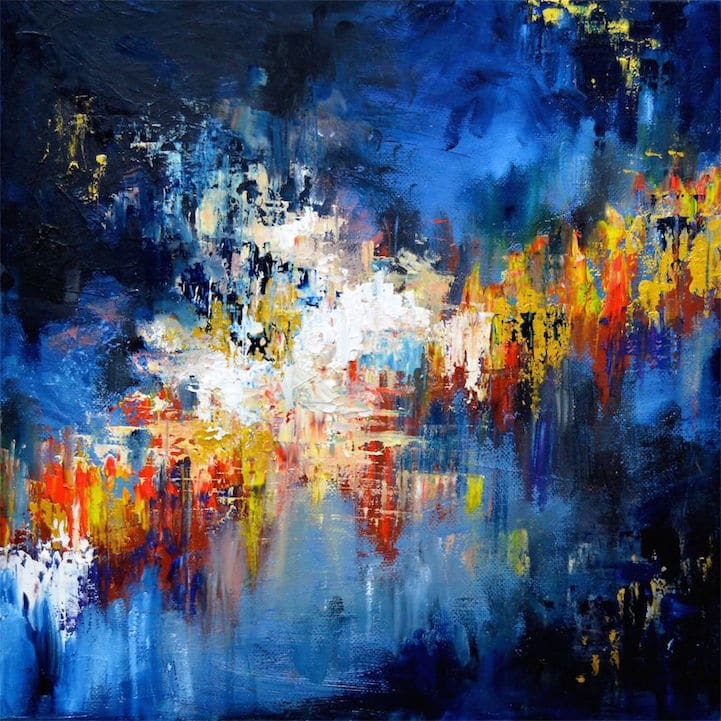
Melissa McCracken is a 36 year old artist from New York. She paints what she sees when she listens to popular songs. She paints in order to allow others to visualize what she experiences every day. Her synesthesia goes beyond just seeing colors from music, as she has also stated that ”each letter and number is colored and the days of the year circle around my body as if they had a set point in space.”
My Process
For my materials, I used acrylic paint on paper secured down with masking tape. I used my well-loved Walmart brushes, as I work with what I’ve got on hand, and good materials don’t automatically make good art. I’m going to listen to some jazz music (E’s Jammy Jams – Peacefully), because it’s a very fluid and image-provoking genre of music for me, and I get more of a sense of movement and color from listening to it than any other kind of music.
Here are some of the things I kept in mind as I paint:
- Colors and saturation
- Shapes and lines
- Light and shadow
- Composition
Using these elements, I asked myself what looked right as I listened and painted. I heard cool tones, so I primarily stuck to blues, greens, and purples. The faint sound of rain gave me the imagery of puddles, so I made circular and swirly shapes with watered down paint. There were flecks of warmth in the sound, so it felt right for yellow ochre to be sparsely dispersed throughout, mostly seen in the right top corner. I ended up using more black than I originally expected, but I think the small interstices of white from the paper balance it out. I believe this exercise is a success, and my finished piece is representative of what I imagined in my head while listening to music.
Watch my process here!

Leave a Reply